The medical information in this article was written by Yasir Gozu, MD (General Surgery Specialist) and checked against current medical sources.
This article is for information purposes only; it is not a substitute for an examination and a physician’s assessment.
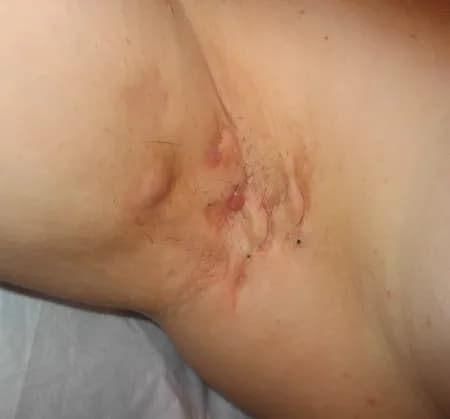
Known in Turkish by the folk name "köpek memesi"; medically, hidradenitis suppurativa (HS): this is a chronic skin disease marked by recurrent painful lumps, abscesses and draining tunnels in the armpits, groin, under the breasts and around the anus. Contrary to common belief, it is not a "sweat gland infection" or a germ-borne illness, but an inflammatory disease that develops on a background of blocked hair follicles; it is not contagious and has nothing to do with hygiene. Its two strongest triggers are smoking and excess weight. Caught at an early stage, it is controlled very well with medication and laser; neglected, it forms tunnels and requires surgery.
When I make this diagnosis in my practice, I see two reactions at once: first surprise: "this actually has a name?"; then relief. Because these patients typically go years without a diagnosis: each time they were told it was a "boil", given antibiotics, had the abscess drained... and the lumps stubbornly came back. Some doubted their own hygiene; some were too embarrassed to show anyone. In this article we will put a name to that cycle: hidradenitis suppurativa; or HS. And most importantly: we will explain that this is not fate, but a treatable disease.
Where does the folk name come from, and what is the disease really?
The Turkish folk name "köpek memesi" (literally "dog's teats") comes from the appearance of the lumps lined up in the armpit; likened to the row of teats on a dog's belly. The medical name, hidradenitis suppurativa, actually carries a historical misconception of its own: it means "suppurative inflammation of the sweat glands", yet today we know the disease does not start in the sweat glands. The real mechanism is this: the mouth of a hair follicle becomes blocked, the blocked follicle swells and bursts beneath the skin; as its contents spread under the skin, the body mounts a fierce inflammatory response. Repeated attacks gradually create tunnels (sinus tracts) and firm scars under the skin. In other words, it is not a germ disease but a disease of blockage and inflammation; and that is also the answer to why antibiotics alone are never enough.
Where does it appear?
The disease favors the fold areas where friction and hair follicles are concentrated: the armpits (most common), the groin and genital area, around the anus, under the breasts and the buttocks. In women, armpit and groin involvement is more prominent; in men, the area around the anus. Perianal involvement is what concerns my own field most: HS around the anus is frequently confused with an anal fistula; see the symptoms article for how to tell them apart. Let me add a note: HS belongs to the same disease family as the pilonidal sinus (both develop on a background of blocked hair follicles) and the two can occur together in the same patient.
Who gets it, and why?
HS typically begins after puberty and peaks between ages 20 and 40, and is somewhat more common in women. The predisposing factors: genetics: a third of patients have a similar story in the family; smoking: the strongest environmental trigger, both starting the disease and worsening it; excess weight: it increases friction and the inflammatory load; hormonal influences: flare-ups around menstruation are typical; and mechanical irritation (tight clothing, aggressive shaving). Let me underline this in bold: it has nothing to do with hygiene and it cannot be passed to anyone. These two sentences throw away the most needless part of the shame my patients have carried for years.
How does it progress? Three stops
The typical journey of untreated HS has three stops. First stop: occasional painful lumps the size of a chickpea to a hazelnut; most settle on their own or after bursting, but they return to the same area. Second stop: the abscesses become more frequent and begin to connect to one another through tunnels under the skin; discharge and odor gnaw away at quality of life. Third stop: the area becomes covered with firm scars and a web of tunnels; even raising the arm can become difficult. In medicine these stops are called the Hurley stages. I have covered them in detail in the staging article. My message is clear: the stops run one way only; those who board early get off early. For the full price of neglect, see the what happens if it goes untreated article.
Boil, cyst, pimple... telling HS apart from its imitators
A one-off boil is not HS. The signature that points to HS is this: lumps appearing in the same areas, again and again, for years; double-headed blackhead formations (double comedones); and the tunnels and scars that develop over time. The sentence "Every time a boil comes up I take antibiotics and get by, but it keeps coming back" is almost diagnostic in my practice. A detailed differential table is in the symptoms article.
Treatment: No room for pessimism
HS is a chronic disease. I will not hide that. But "chronic" does not mean "hopeless"; asthma and migraine are chronic too, and they are managed. The treatment options are lined up by stage: lifestyle changes (quitting smoking and losing weight; the two most powerful non-drug treatments; see the home care article), medication (antibiotic courses to quench the inflammation; see the medication article; biologic drugs in resistant cases), laser treatments (hair-removal laser targeting the follicles at early stages, laser clearing of the tunnels at advanced stages) and surgery (removal of established tunnel networks; see the aftercare guide). When the right step is chosen at the right stage, a patient with HS lives a normal life; the proof is the hundreds of well-controlled patients in my clinic.
When to see a doctor?
If any one of these three applies, it is time for an assessment: a lump has come up in the same area for the third time (a single boil should scare no one; it is the recurring pattern that speaks), draining openings and tunnels have appeared between the lumps, or pain, odor and discharge have begun to affect your clothing, your work or your social life. The patient who comes early is treated with creams and laser; the patient who comes late, with surgery; the difference between the two is, most of the time, simply time.
Frequently asked questions
Is hidradenitis suppurativa contagious?
Absolutely not; it is not passed on by touch, by towels or through sex. It is not a germ disease but an inflammatory disease that develops on a background of blocked hair follicles.
I am very careful about my hygiene; why is this happening?
Because it has nothing to do with hygiene. Genetic predisposition, smoking, weight and hormonal background are what matter. If anything, overly aggressive cleansing and harsh scrubbing can worsen flare-ups through irritation.
Does it go away on its own?
An occasional attack may settle; but the disease itself does not disappear without treatment; the pattern typically progresses over the years. It may quiet down after menopause, but the tunnels formed until then are permanent.
Is there a cancer risk?
HS is not cancer, and its transformation into cancer is very rare; a rare risk has been described only in advanced-stage cases left untreated for many years, on the ground of a non-healing wound. This is not a reason for panic; it is a reason not to neglect treatment.
Which specialty should I see?
The skin side of the disease belongs to dermatology; the abscess-tunnel-surgery side belongs to surgery; the best results come from the two working together. For involvement around the anus and in the groin, a surgeon with proctology experience is the person who will read the tunnel map most accurately.
Sources
- American Academy of Dermatology (AAD) — Hidradenitis Suppurativa, aad.org
- NHS — Hidradenitis suppurativa, nhs.uk
- American Society of Colon and Rectal Surgeons (ASCRS), fascrs.org
If you have had "boils" recurring for years, let's look at them through this lens for once: 444 8 623 — Levent.
Yasir Gozu, MD
General Surgery Specialist
He has worked in anorectal diseases (proctology) for over twenty years, focusing on non-surgical laser treatments for hemorrhoids, anal fistula, anal fissure and pilonidal sinus. He sees patients at Avrupa Cerrahi in Besiktas Levent.
Content owner: Yasir Gozu, MD
Published: April 9, 2026
Last updated: September 9, 2026