This article is for information purposes only; it is not a substitute for an examination and a physician’s assessment.
In HS, antibiotics are usually given not to kill germs but to suppress inflammation — which is why "it came back when I finished the course" is no surprise: the drug puts out the flame but does not change the ground. The steps: topical clindamycin in early-stage disease; tetracycline-group courses (lasting weeks) for widespread involvement; the clindamycin + rifampicin combination (typically 10-12 weeks) in resistant cases. Grabbing a random antibiotic from the pharmacy at every flare, on the other hand, both fails to work and builds up resistance. Where antibiotics fall short, biologic drugs and interventional treatments come into play.
Nearly all HS patients have used antibiotics many times before they come to me — and most say the same sentence: "It helps while I'm taking it, then it comes back when I stop." That observation is correct, and hidden inside it is the entire logic of HS antibiotic therapy. In this article I will unpack that logic: which drug in which situation, for how long, expecting what — and most importantly, where the limit of antibiotics lies. Let me warn you upfront: nothing below is a recipe for starting medication on your own; dosing and selection are personalized through an examination.
First, the logic: what do antibiotics do in HS?
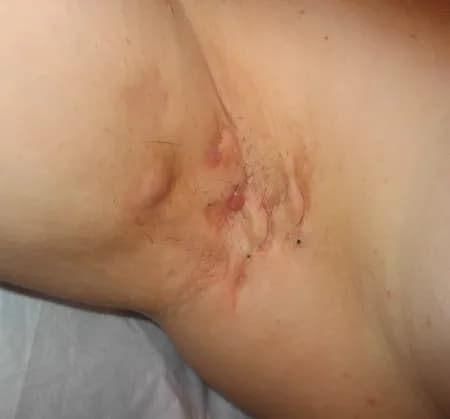
The intuitive expectation is: "There's inflammation, so there's a germ; the antibiotic kills it, done." But as I explain in the guide article, HS is not an infectious disease but an inflammatory one that develops on a ground of blocked hair follicles. Bacteria join the picture later, secondarily. The real value of the antibiotics we use in HS lies in their anti-inflammatory — inflammation-calming — effects; it is the same reason the tetracycline family has been used in acne for decades. This one fact explains two things at once: why they are given for weeks (not in short courses) and why the disease can return when they are stopped — the drug puts out the fire, but the ground that produces the sparks (blocked follicles, smoking, weight, genetics) stays in place.
Step 1: Topical clindamycin — the cream-lotion level
In early-stage, limited involvement, the first choice is usually clindamycin applied to the skin: twice a day, on the affected area, typically for weeks. Widespread side effects are few; dryness and irritation are the most common. Let's set expectations correctly: topical treatment reduces flare frequency in mild involvement; it is not strong enough for tunneled disease. At this step, the real gain comes from the lifestyle changes placed alongside the drug (home care).
Step 2: The tetracycline group — systemic courses
If more than one area is involved, or topical treatment is not enough, an oral tetracycline-group drug (most often doxycycline) is started — a typical course lasts weeks; expecting results after a few days of use is a false expectation. Practical warnings: it can cause sun sensitivity (protection in summer), it is not used in pregnancy, and it should not be taken at the same time as dairy products (absorption drops). The goal at the end of the course is a marked reduction in flare frequency and severity; complete silence is not realistic for every patient.
Step 3: Clindamycin + rifampicin — the heavy-artillery combination
The classic protocol for moderate-to-severe, stubborn HS is this duo: oral clindamycin and rifampicin together, typically for 10-12 weeks. In the right patient the results are impressive — discharges dry up, pain recedes, and the patient experiences a "normal" stretch for the first time in years. Things to know: rifampicin stains urine and tears orange (harmless, but alarming if you don't know), it reduces the effectiveness of birth control pills (a backup method is a must), and if clindamycin causes diarrhea, it must be reported. And the honest statistic: relapse after the combination is possible — which is why this course is usually designed as a bridge that opens the way for the definitive plan (laser, surgery, biologics).
When antibiotics run out: the road continues
In disease that cannot be suppressed with courses or relapses quickly, two doors open. Biologic drugs: injectable treatments that target the signaling molecules at the source of the inflammation (adalimumab is approved in this field); they are managed jointly with dermatology and are game-changing in the right patient. Interventional treatments: established tunnels do not close with medication — laser/deroofing or surgery is needed. The summary formula: medication suppresses the inflammation, procedures clear the tunnels, lifestyle change fixes the ground. The three work together.
What not to do: the art of accumulating resistance
Grabbing "the antibiotic that helped last time" from the pharmacy at every flare is the most widespread mistake in HS management: random, short, untargeted courses do not solve the disease but leave two lasting harms — resistance in the bacteria, and in the patient, the illusion that "antibiotics don't work." The second mistake is abandoning the combination course halfway because "I'm better"; a half course is an invitation to a full relapse. The third: trying to "melt" an abscess with antibiotics — a tense, throbbing abscess demands drainage; it does not wait for pills.
Frequently asked questions
Which is the strongest antibiotic? Why not start with that one directly?
In HS there is no "strongest"; there is "most appropriate" for the stage and the involvement. Starting early with heavy weapons brings the cost of side effects and resistance forward without adding benefit. The step logic is not there for nothing.
Doesn't taking antibiotics for months harm the body?
In supervised courses, the benefit-harm balance is watched; liver values and side effects are monitored. The real harm lies in unsupervised, random use. Discuss your concern with your physician; do not cut the course short on your own.
What if I skip antibiotics and go straight to laser/surgery?
In some patients that really is the right course — especially in tunneled cases with limited benefit from medication. But a procedure performed during active inflammation has a lower success rate; in most plans we first calm things with medication and then operate. The sequencing is tactical and is set at the examination.
Should I take probiotics?
Supporting the gut flora during long antibiotic courses can be reasonable; there is no evidence that they treat HS itself. Think of them as secondary support, not treatment.
Sources
- American Academy of Dermatology (AAD) — Hidradenitis Suppurativa, aad.org
- NHS — Hidradenitis suppurativa, nhs.uk
Let's determine the right step for you — and the real place of antibiotics in your case — at an examination: 444 8 623, Levent.
Content owner: Yasir Gozu, MD
Published: April 7, 2026
Last updated: July 8, 2026