The medical information in this article was written by Yasir Gozu, MD (General Surgery Specialist) and checked against current medical sources.
This article is for information purposes only; it is not a substitute for an examination and a physician’s assessment.
Untreated HS typically progresses: isolated abscesses form tunnels, tunnels form networks, and the area becomes covered in permanent hard scars. The cost is not only to the skin: constant discharge and odor, restricted movement, anemia, depression, and social isolation join the picture; in cases neglected for years, rare but serious risks (cancer developing in the chronic wound bed) have been described. Fortunately, the chain can be broken at every link: the stage you are in today becomes your final stage if you start treatment.
"Doctor, it's been like this for years. I'm used to it by now." I hear this sentence from HS patients so often that I am writing this article as a direct answer to it. Getting used to it is not an innocent strategy in HS, because this disease grows while it waits. Below I will describe the typical route of HS left untreated; without exaggeration, but without softening it either.
The skin front: From abscess to tunnel network
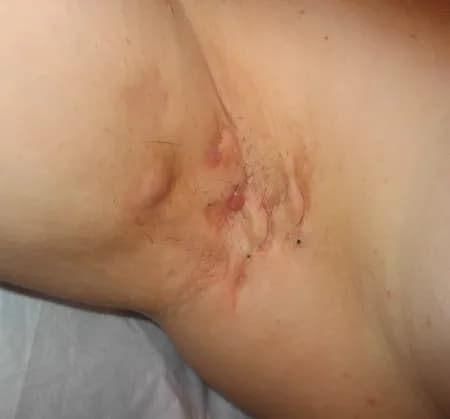
In the first years the flares seem to "come and go"; the real damage accumulates silently. Every abscess that bursts leaves a small cavity under the skin; cavities merge into tunnels, and tunnels merge into networks. In networked tissue, two things become constant: discharge and inflammation. The body repairs every flare with scar tissue; over the years the area becomes encased in a stiff armor that has lost its elasticity. I described the stops along this route in the staging article; the critical sentence here is this: the road from stage 1 to stage 3 is, most of the time, the road of untreated years.
The movement front: The price of the armor
This is the under-discussed consequence of advanced disease: scar tissue wrapping the armpit can prevent the arm from being raised fully (contracture); with groin and buttock involvement, sitting, walking, and exercising become painful. For a patient whose profession depends on the use of their arm, this can go as far as losing their job. Once scar tissue is established, the only solution is surgery; preventing it before it forms is always easier.
The body front: Silent exhaustion
Years of active inflammation produce consequences that go beyond the skin: chronic fatigue and anemia (the classic toll of constant inflammation), resistance problems from frequent antibiotic courses, and pain disrupting sleep. In widespread cases left uncontrolled for a long time, rare inflammatory protein deposits that can affect the kidneys have been reported. And out of honesty I write this; not to cause panic: in a wound bed that has remained draining and unhealed for decades, rarely, skin cancer (squamous cell) can develop. This risk is small, but its existence is the strongest argument against "normalizing life with a chronic wound"; in a neglected area, any new, non-healing wound that changes character must be evaluated with a biopsy.
The mental and social front: The invisible bill
In quality-of-life research, HS measures among the most wearing of all skin diseases; ahead even of psoriasis and eczema. The reason is not hard to guess: outings canceled for fear of odor and discharge, summers without the sea or sports, intimacy turned into something to avoid, wardrobes full of loose black clothes chosen in case "they notice"... Depression and anxiety are complications of HS: not weaknesses of character. Leaving them out of the treatment plan is leaving half the disease untreated; when needed, we consider mental health support a natural part of the plan. I described the cycle in which stress and the disease feed each other in a separate article.
The trap of "managing" methods
The untreated patient is not actually doing nothing; they are doing the wrong things: random antibiotics from the pharmacy at every flare (builds resistance, does not solve the disease), squeezing and popping the lumps (spreads infection deeper, accelerates tunneling), repeated emergency-room drainages (saves the day, does not change the pattern), and precious months spent on herbal mixtures. What these all have in common is this: they all target the flare, not the disease. In HS, the plan is not to extinguish flares but to break the pattern.
Breaking the chain: The one thing to do today
The purpose of this article is not fear but momentum. The truth is this: there is a treatment step that works at every stage of HS (all of them in the guide), and whatever stage the disease is in when treatment begins, that is typically where it is stopped. In other words, the most powerful variable in the equation is time. The one thing to do today is book an examination; the rest (staging, planning, laser or surgery if needed) is our job.
Frequently asked questions
I have gone untreated for years; is it too late now?
No; there is no such thing as too-late HS, only HS that has grown in scope. Even at stage 3, surgery restores quality of life dramatically. The only real meaning of being late is that the treatment is more extensive.
My flares have become less frequent; will the disease burn out on its own?
Periods of calm do occur (especially after menopause); but established tunnels and scars remain in place, and the quiet period is not always permanent. A quiet spell is the best time for treatment; the war is won during the ceasefire.
Isn't constant antibiotic use harmful too?
Unplanned, random use; yes. Planned courses are different: a defined duration, a defined target, with follow-up. The difference is in the medication article.
How much should the cancer risk scare me?
Very little; it is rare and it is the risk of decades of neglect. The right response is not fear but doing two things: getting the disease treated, and showing any wound in a chronically affected area that changes character to a doctor without delay.
Sources
- American Academy of Dermatology (AAD) — Hidradenitis Suppurativa, aad.org
- NHS — Hidradenitis suppurativa, nhs.uk
Before you say "I'm used to it," let us talk once; the chain can be broken today: 444 8 623, Levent.
Yasir Gozu, MD
General Surgery Specialist
He has worked in anorectal diseases (proctology) for over twenty years, focusing on non-surgical laser treatments for hemorrhoids, anal fistula, anal fissure and pilonidal sinus. He sees patients at Avrupa Cerrahi in Besiktas Levent.
Content owner: Yasir Gozu, MD
Published: July 12, 2025
Last updated: September 9, 2026