The medical information in this article was written by Yasir Gozu, MD (General Surgery Specialist) and checked against current medical sources.
This article is for information purposes only; it is not a substitute for an examination and a physician’s assessment.
In HS surgery the wound (by the very nature of the disease) is usually not stitched but left open, and it heals by filling in from the base upward: that means weeks of regular dressing changes. The essence of this guide: put the dressings on a schedule (daily in the first weeks), use showering as an early freedom (running water is the wound's friend), in armpit surgery do not neglect shoulder exercises (they prevent contracture), and know the warning signs. The reward of wide excision is that recurrence in that area becomes rare: patience is the price of permanence.
In the pre-operative consultation I always tell my patients the same thing: "I will treat you on the operating table; but for the following six weeks, you will be treating yourself." HS surgery is among the most care-intensive procedures in proctology and skin surgery; because we usually leave the wound open on purpose. This article is the user's manual for those six weeks: what is normal, what is not, and when to call.
Why an open wound? Knowing the logic makes patience easier
The intuitive question is fair: "If you cut it out, why not stitch it up?" For two reasons. First, HS tissue is an inflamed terrain; an inflamed cavity stitched shut raises the risk of abscess recurrence, while a wound left open closes by filling cleanly from the bottom up. Second, tight suture lines in skin-fold areas tend to break open. That is why, although small excisions are sometimes stitched, in moderate-to-wide clearances secondary healing (leaving the wound open) is usually a deliberate choice; for very large areas, graft and flap plans with plastic surgery come into play. We discuss which route is chosen and the expected timeline before surgery. I do not like surprises.
Dressings: The foundation of recovery
In the first weeks the routine is usually this: a dressing change once a day (twice if drainage is heavy); the wound is washed, the recommended dressing is placed (usually modern dressings that maintain a moist wound environment, or simple petroleum jelly gauze), and it is covered. In the first days we ask that this be done at a healthcare facility or with a relative we have trained; most patients become masters of their own dressing within a few days. Two practical truths: dressing changes sting in the first week (taking a painkiller 30-40 minutes beforehand is wise), and the yellowish-pink seepage from the wound is not infection but healing fluid: it is different from foul odor and green-dark discharge.
Showering: Not a restriction, but a treatment
The rule that surprises patients most: with an open HS wound, showering is not forbidden; it is encouraged. It usually starts 24-48 hours after surgery: the dressing comes off, warm water is run over the wound (soap around it, not rubbed into it), you dry with a clean towel by blotting, not rubbing, and a fresh dressing goes on. Running water is the gentlest cleaner of a wound surface and makes dressing changes easier. Soaking in a tub and pools or the sea, however, are off-limits until the wound has closed; running water is a friend, standing water is not.
Fine points by body area
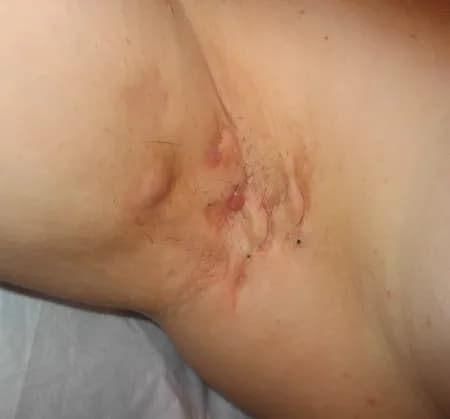
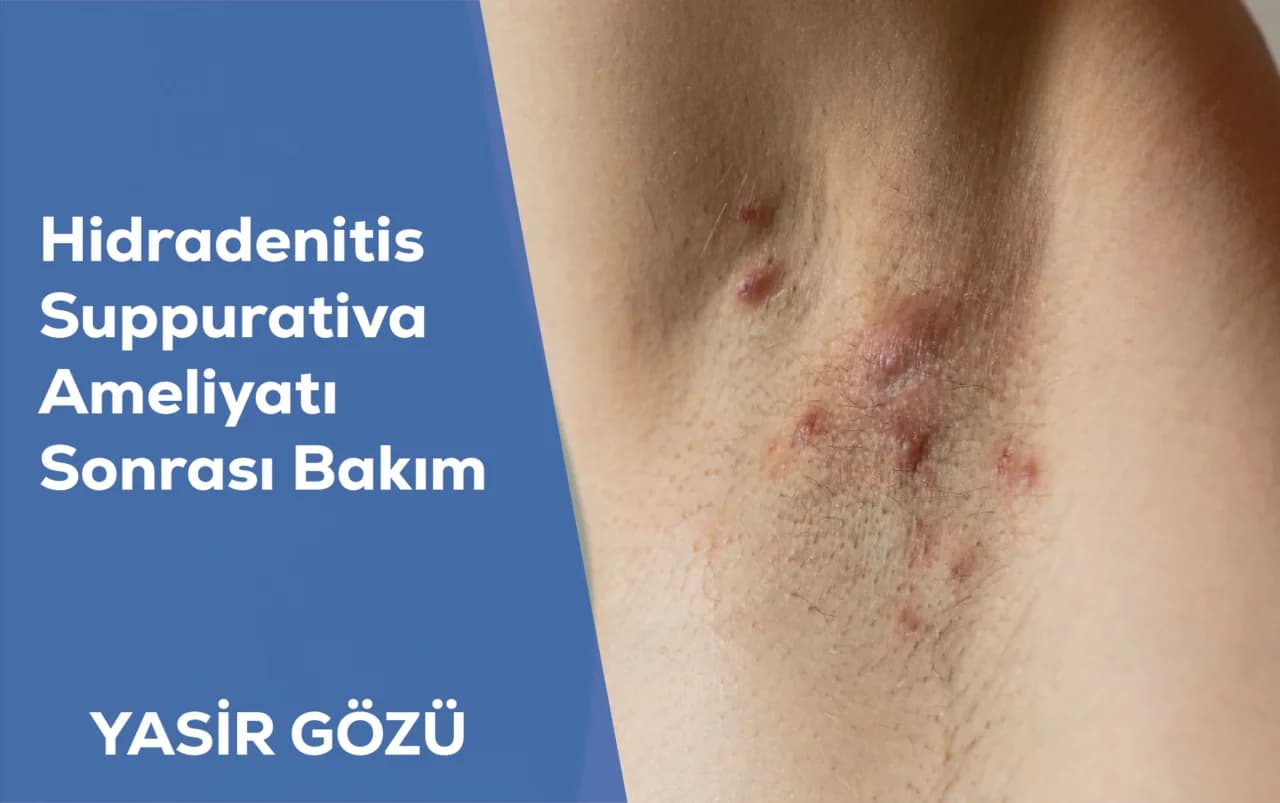
Armpit: the most important item is exercise; the healing wound tries to restrict shoulder movement; unless you do gentle shoulder stretches several times a day (walking your fingers up a wall is the classic), healing can end in contracture (permanent restriction). At the edge of pain, regular, gentle: those are the three rules. Groin and genital area: loose underwear, gentle cleansing after every toilet visit; walking is fine, but straddling positions (bicycle, motorcycle) are not appropriate until the wound closes. Around the anus: cleansing with water after bowel movements, plus an extra dressing change on top of the daily one if needed; keeping stools soft (fiber and water) is the rule here too. Under the breast and buttocks: positioning that reduces friction and keeping the area dry are essential.
Timeline and return to work
A rough framework; it shifts with wound size: after small-to-moderate excisions, desk work resumes in 3-7 days; after wide excisions, in 1-2 weeks; physical labor requires 2-4 weeks depending on the wound's location. Wound closure can take 3-4 weeks for small wounds and 6-8 weeks for large areas; with graft-flap plans, the surgical team sets the calendar. The final quarter of healing is the riskiest period; if care slackens because the wound has shrunk, the process drags on. In a closed wound, the scar tissue continues to mature for months; we give massage and moisturizing advice at follow-up visits.
Warning signs
Do not wait for your follow-up appointment with these: fever above 38°C (100.4°F); spreading redness and warmth around the wound; foul-smelling, dark-green discharge; bleeding that will not stop; pain increasing when it should be decreasing; and a new, deep, painful swelling in the neighboring skin (an early recurrence focus; caught small, it stays small; see the recurrence article). Let me add one more: low spirits are also a finding worth reporting; long dressing periods are exhausting, and asking for support is part of the process.
Frequently asked questions
Will the wound stay this big?
No; an open wound visibly shrinks every week; it fills in from the edges and the base at the same time. Do not despair at the first week's appearance; the photo at week four looks entirely different (I recommend weekly photos to most patients; the best medicine for motivation).
I cannot keep up with the dressings; is skipping a day all right?
In a wound that is running dry and clean, one day's flexibility is not a disaster; but breaking the routine breaks the habit. If you cannot keep up, the solution is not to skip but to adapt the routine to your life; we will work it out together.
My surgical site healed, but a lump appeared somewhere else; was the surgery wasted?
No; surgery clears the diseased area; it does not change the disease's underlying terrain (genetics, smoking, weight). A new area is a new, and usually smaller, matter. The terrain is managed by the five home-care steps.
Will there be a scar?
Yes; that is the honest answer; a wound that heals open leaves a scar. But compared with the tunneled, draining, painful tissue HS itself leaves behind, a quiet surgical scar is the outcome my patients prefer without exception. The scar's appearance softens with time and care.
Sources
- American Academy of Dermatology (AAD) — Hidradenitis Suppurativa, aad.org
- NHS — Hidradenitis suppurativa, nhs.uk
- American Society of Colon and Rectal Surgeons (ASCRS), fascrs.org
Let us build both your surgical plan and your care calendar together; no surprises: 444 8 623, Levent.
Yasir Gozu, MD
General Surgery Specialist
He has worked in anorectal diseases (proctology) for over twenty years, focusing on non-surgical laser treatments for hemorrhoids, anal fistula, anal fissure and pilonidal sinus. He sees patients at Avrupa Cerrahi in Besiktas Levent.
Content owner: Yasir Gozu, MD
Published: April 20, 2026
Last updated: September 9, 2026