This article is for information purposes only; it is not a substitute for an examination and a physician’s assessment.
Laser plays two distinct roles in HS. 1) Hair-removal laser: at early stages (Hurley 1 to early 2) it permanently seals the hair follicles and shuts down the disease's "factory" — markedly reducing the frequency of attacks; several sessions are needed. 2) Surgical laser: it opens the roof of established tunnels and cleans their floor (laser deroofing/ablation) — without incisions or sutures, bloodless and same-day. The honest limit: in a stage 3 tunnel network covering the whole area, laser alone is not enough; the solution is surgical excision. The right laser at the right stage is the most comfortable weapon in HS management.
The diseases I treat with laser at my clinic share a common feature: in all of them, laser carries the promise of "fewer incisions, less pain, faster recovery". In HS this promise holds — but on one condition: being clear about which laser is used, at which stage, and for what. Because the laser in the sentence "my neighbor was cured with laser" and the laser you actually need may be two entirely different procedures. Let me explain both.
The first role: hair-removal laser — cutting off the fuel
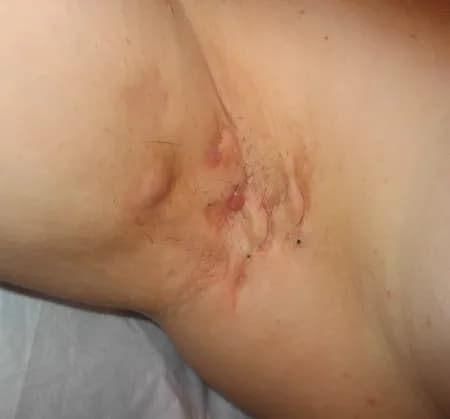
HS is a disease of blocked hair follicles (guide); where there is no follicle, there is nothing to block. The hair-removal laser works on this simple logic: it uses heat to permanently seal the hair follicles in the at-risk area (armpit, groin, buttocks) and dries out the ground where new foci would be established. For whom? The brightest results are in early-stage patients — occasional attacks, skin not yet tunneled: here, hair removal is not "cosmetic" but a therapeutic move that pushes the disease back. Nor is it worthless at advanced stages: it is used to protect the surroundings of a cleared area and to prevent recurrence. In practice: it is applied in sessions (several, because of the hair cycle), it is done in a quiet period rather than during a flare, and in dark-skinned patients the choice of device and dose demands experience.
The second role: surgical laser — clearing the tunnels
Established sinus tracts (tunnels) do not close with medication; the classic solution is surgically opening the tunnel roof (deroofing) or excising the tissue. The surgical laser does this job without an incision: fine laser energy opens the tunnel's roof, vaporizes and cleans the inflamed floor, and — because it seals whatever it touches as it goes — leaves a bloodless field. Its advantages over the classic incision are clear: less tissue loss, a more comfortable recovery, a same-day procedure and no suture problems in the fold areas. Small-to-medium open areas remain after the procedure and, with the rules of open wound care, they usually close faster than after conventional surgery.
Matching stage to laser: in one table
| Stage | Picture | Laser's place |
|---|---|---|
| Hurley 1 | Occasional attacks, no tunnels | Hair-removal laser: the main protective move |
| Hurley 2 | Recurrent attacks + limited tunnels | Tunnel clearing with surgical laser + hair removal around the area |
| Hurley 3 | Tunnel network covering the area | NOT enough on its own — surgical excision is the mainstay; laser assists |
The last row of the table is the most honest sentence in this article: in stage 3 disease that has engulfed the entire area, the promise "we'll sort it out with laser" is not realistic — without wide surgical removal of the diseased ground, no lasting result is achieved. Laser is still on stage there, but not in the lead role: it serves to clean the border zones and to protect against recurrence.
The procedure: how does it work at our clinic?
First, examination and staging — a tunnel map is drawn up (with ultrasound support if needed), and the background of smoking, weight and medication is discussed. If there is an active, tense abscess, it is calmed first (drainage or brief medication support); laser works best on quiet ground. On the procedure day: local or brief anesthesia, 15-40 minutes (depending on the number of tunnels), a few hours of observation, home in the evening. Showering is allowed the next day; return to desk work usually takes 2-4 days. At follow-ups, healing is monitored and the plan is completed: remaining sessions, the hair-removal program, and a bridge of medication if required. The laser experience at the heart of our proctology practice — thousands of procedures in diseases of the anal region — serves us especially well in perianal and groin HS: you work with a team that lives the surgical subtleties of these areas every day.
Managing expectations: the promise laser cannot make
Laser cannot erase the genetic ground of HS — the treated area is cleared, but in a patient who keeps smoking and gaining weight, the disease can knock at the door from another skin fold. That is why the same trio is always placed alongside the laser plan: a smoking intervention, a weight target, and a home care routine. Nor is laser at odds with the medication step: suppressing widespread inflammation first with an antibiotic course and then clearing with laser is a sequential plan we use often.
Frequently asked questions
Can I have the hair-removal laser done at a beauty salon?
In an HS patient this is a medical treatment: the dose, the choice of device and the timing around attacks must be tailored to the disease, and the skin must be monitored by a physician's eye. The beauty salon standard is for healthy skin; not for HS skin.
Is laser tunnel clearing painful?
The procedure is done under anesthesia; afterwards, most patients describe it as "milder than I expected" — the laser's bloodless, sealing nature makes for a calmer recovery than a classic incision.
How many sessions are needed?
For the surgical laser, most limited cases take a single session; with widespread tunnels, it is planned region by region. Hair removal, by its nature, takes multiple sessions (the hair cycle). The exact number can only be given once your tunnel map is drawn — do not trust a number given sight unseen.
What does it cost?
It depends on the scope: the number of tunnels, the region, whether hair removal is included... After the examination we provide an itemized written price; we do not quote prices over the phone, because a price given without seeing you misleads.
Sources
- American Academy of Dermatology (AAD) — Hidradenitis Suppurativa, aad.org
- NHS — Hidradenitis suppurativa, nhs.uk
Let the examination tell which laser will serve your stage: 444 8 623 — Levent. For an overview: the hidradenitis suppurativa guide.
Content owner: Yasir Gozu, MD
Published: April 9, 2026
Last updated: July 8, 2026