The medical information in this article was written by Yasir Gozu, MD (General Surgery Specialist) and checked against current medical sources.
This article is for information purposes only; it is not a substitute for an examination and a physician’s assessment.
HS is a chronic, relapsing disease; "coming back" means two different things: ongoing disease activity (common after medication courses; the underlying terrain stays in place) and recurrence in the treated area (rare after wide surgery; though a new focus can appear elsewhere). The four factors that lower recurrence: quitting smoking, losing weight, laser hair removal, and regular follow-up. The long-term picture is hopeful: in most patients, disease activity fades with age (especially after menopause).
The patients who ask me this question most often have just finished a course of treatment; their voice carries both hope and fear: "Is it over, or will it come back?" My honest one-sentence answer is this: the risk of recurrence in HS is real, but it is your variable, not your fate; it changes dramatically depending on what you treated and how, and on whether you manage four critical factors. Let's unpack that answer.
First, let's clarify terms: Two different kinds of "recurrence"
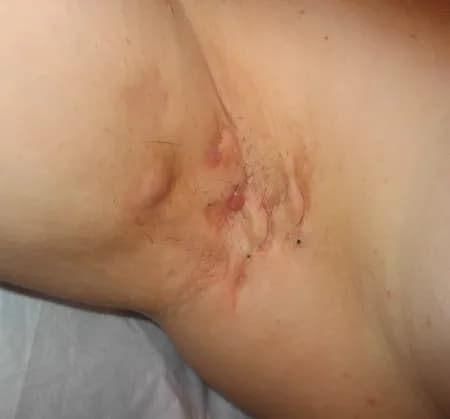
Patients describe both with a single word, but medically they are distinct. The first is disease activity: HS is by definition a relapsing disease; as long as the underlying terrain I described in the guide (genetics and hair follicles prone to blockage) remains in your body, new flares are possible in any area. The second is recurrence in the treated area: the disease re-establishing itself in a specific area that was quieted with medication or cleared with a procedure. This distinction matters, because in a patient who says "I had surgery, but it came back at the other end of my armpit," the surgery has not failed; the disease has simply followed its nature. Accordingly, treatment has a two-layered goal: clearing the area and lowering the activity of the underlying terrain.
An honest recurrence picture, treatment by treatment
After antibiotic courses: recurrence is most common here; the medication suppresses the inflammation but does not touch the blockage-prone terrain (the "fire versus spark" issue in the medication article). Flares returning within months after a course is not the drug failing; it is the drug's nature; which is why courses serve, in most plans, as a bridge to the lasting moves (laser, surgery, lifestyle change). After local procedures (drainage of a single abscess, limited deroofing): the treated focus closes, but a new focus can form from neighboring follicles; regional recurrence is moderately common. After wide surgical excision: when the diseased tissue is removed together with its follicles, recurrence in that area is rare: this is the most durable move in HS treatment; the price is a longer healing process (aftercare guide). Biologic drugs: they suppress the disease while you take them; activity usually returns when they are stopped; they are planned on the logic of chronic treatment for a chronic disease.
The four factors that lower recurrence
Whichever treatment you have, these four levers determine your odds of recurrence. 1) Smoking: in a patient who keeps smoking, no treatment has a good recurrence rate; quitting shifts every statistic in your favor. 2) Weight: even a 5-10% loss weakens the ground flares grow from (the diet article). 3) Laser hair removal: permanently closing the hair follicles in at-risk areas dries up the possibility of a "new focus" at its source; it is the HS counterpart of its protective role in pilonidal sinus (the laser article). 4) Regular follow-up: one or two check-ups a year plus early reporting of flares; a recurrence caught early closes with a procedure as brief as a coffee break; one left to grow demands surgery.
The long term: The disease's retirement age
Here is a rarely mentioned, reassuring fact about HS: its activity does not run at the same pace for life. The disease is typically at its loudest between ages 20 and 40; after that; especially in women, with menopause: flare activity fades noticeably in most patients. This does not justify a "let's wait, it will burn out anyway" strategy: the tunnels and scars that form until the fade-out age are permanent, and those years are the most productive years of life. The right reading is this: treatment is a plan for getting through the loud years under control; and time will eventually come over to your side.
If recurrence happens: Catch it while it is small
It starts with familiar signs: a deep, painful swelling in the old area or in a new skin fold. What to do: warm compresses and tightening up your home-care routine and (this is the critical part) coming in for a check-up without waiting for the second or third flare. Early-stage recurrence is treated lightly: a short course of medication and, if needed, laser closure of the single focus. A recurrence watched for months on the hope that "it will pass" grows into tunnels. The rule is the same as for the disease itself: in HS, time is half the treatment.
Frequently asked questions
If I have surgery, is there a guarantee?
I never use the word guarantee in medicine; but I will say this: recurrence in an area cleared by wide excision is rare, and it becomes rarer still in a patient who manages the smoking-weight-hair-removal trio. Instead of "guarantee," call it "your strongest hand."
Is a recurrence always more severe?
No; that is a myth. A recurrence caught early usually runs milder than the original disease and closes with a minor intervention. Worsening is only the story of a neglected recurrence.
I am afraid of passing it to my child; is it hereditary?
Familial predisposition is real; about one in three patients has a family history. But predisposition is not destiny: in a young person who does not smoke and manages their weight, the disease may never wake up, or may run mild. Early evaluation at the first signs is your child's greatest advantage.
How many flare-free years before I can say I am "cured"?
There is no official threshold; complete silence for more than two years plus a clean examination means, in practice, "under control." I reserve the word "cured" for post-menopausal cases that have burned out and stayed silent for years; cautious but realistic.
Sources
- American Academy of Dermatology (AAD) — Hidradenitis Suppurativa, aad.org
- NHS — Hidradenitis suppurativa, nhs.uk
Let's shrink your recurrence risk together; set up the four-factor plan and start your follow-up: 444 8 623, Levent.
Yasir Gozu, MD
General Surgery Specialist
He has worked in anorectal diseases (proctology) for over twenty years, focusing on non-surgical laser treatments for hemorrhoids, anal fistula, anal fissure and pilonidal sinus. He sees patients at Avrupa Cerrahi in Besiktas Levent.
Content owner: Yasir Gozu, MD
Published: May 1, 2026
Last updated: September 7, 2026