The medical information in this article was written by Yasir Gozu, MD (General Surgery Specialist) and checked against current medical sources.
This article is for information purposes only; it is not a substitute for an examination and a physician’s assessment.
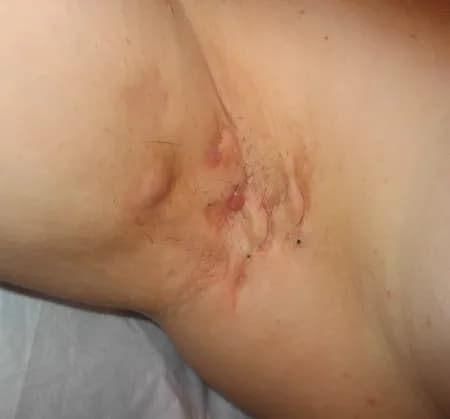
HS is classified into three stages according to the Hurley system. Stage 1: occasional isolated abscesses, no tunnels or scarring; the best chance of control with medication and laser hair removal. Stage 2: recurrent abscesses and limited tunnels and scarring; regional interventions (deroofing, laser) are added to medical treatment. Stage 3: tunnel networks covering the area and widespread firm scarring; the solution is largely surgical. Stages move in one direction only; quitting smoking and losing weight and early treatment are the three brakes that stop progression to the next stage.
When I tell a patient “Hurley stage 2,” I see the question mark on their face; and rightly so, they're likely hearing the term for the first time. Yet this small label is the compass of HS management: it tells us which medication makes sense, whether we should be talking about laser or surgery, what we've already lost, and what can still be saved. In this article, I'll walk through the three stages from the patient's point of view; with enough clarity to answer the question, “which one am I?”
Why does staging matter so much?
Because most treatment mistakes in HS come from treatment that doesn't match the stage. Giving only antibiotics to a stage 3 patient is like pointing a garden hose at a forest fire; recommending extensive surgery to a stage 1 patient is like using a cannon on a sparrow. Staging matches the treatment to the true scale of the disease. Here's the second reason: stage is a measure of time. The Hurley system moves in one direction only; the disease doesn't drop from 3 back to 2 on its own. Your stage today draws the boundary of the decisions available to you tomorrow.
Hurley Stage 1: The period of isolated lumps
The picture: occasional, isolated, painful lumps or abscesses; no tunnels under the skin, no permanent scarring. The skin returns to normal between flares. The large majority of patients are at this stage; and unfortunately, many are misdiagnosed here as having a simple “boil.” Yet this is exactly the golden window: at this stage, the disease can still be pushed back. Treatment: topical or short-course antibiotics (medication article), laser hair removal (which closes off the hair follicles; the disease's factory, so to speak), smoking and weight intervention, and an at-home care routine. A patient caught at stage 1 often never even hears the word “surgery.”
Hurley Stage 2: Tunneling begins
The picture: abscesses are now recurrent; limited tunnels have formed between some of the affected spots, with firm scarring in places; but only islands of the affected area are involved, not the whole region. Drainage comes and goes; odor becomes an issue. This is HS's broadest and most critical stage: a great deal can still be saved, but medication alone is no longer enough. Treatment is layered: courses of systemic antibiotics suppress the inflammation; established tunnels are cleared one by one with deroofing (opening the roof of the tunnel) or laser; in resistant, widespread cases, biologic drugs come into the picture. My analogy is this: stage 2 is the moment a fire has spread to several rooms but hasn't engulfed the building; you have to put out the flames and repair the damaged rooms at the same time.
Hurley Stage 3: The period of tunnel networks
The picture: the affected area (often the entire armpit or groin) is covered with interconnected tunnel networks, constant drainage, and widespread firm scarring. No island of healthy skin remains; arm movement can be restricted, and sitting can become difficult. At this stage, I have to be honest: medication and local procedures can only calm the flares; the lasting solution is surgical removal of the diseased tissue: with a comprehensive plan, working together with plastic surgery if needed (post-surgical care). It's a heavy picture; but let me add this too: with the right surgery, the lives of stage 3 patients are, quite literally, rebuilt. The patients I regret most aren't the ones who reach stage 3; they're the ones who never had to.
The three stages at a glance
| Stage 1 | Stage 2 | Stage 3 | |
|---|---|---|---|
| Lump/abscess | Occasional | Recurrent | Constant, widespread |
| Tunnels | None | Limited, in islands | Network covering the area |
| Scarring | None | In places | Widespread, restrictive |
| Main treatment | Medication and laser hair removal | Medication and deroofing/laser | Surgical excision |
| Goal | Push back | Stop and repair | Rebuild |
Three brakes that stop progression to the next stage
Stages aren't fate; the speed of progression depends largely on modifiable factors. Brake 1; smoking: HS's strongest accelerator; in patients who quit, I regularly see flare frequency drop. Brake 2; weight: every extra kilo means more friction and inflammatory load in skin folds; you'll find details in the diet article. Brake 3; early and regular treatment: suppressing flares with consistent follow-up instead of managing them with an “it's over, forget it” attitude. When all three brakes are used together, progression from stage 1-2 HS to stage 3 becomes the exception rather than the rule.
Frequently asked questions
Can I determine my own stage?
Roughly, yes: if there are no tunnels or scars, it's stage 1; limited tunnels and scarring, stage 2; the entire area involved, stage 3. But the true map of the tunnels under the skin only emerges on examination (with ultrasound if needed); what's visible on the surface is often just the tip of the iceberg.
Can different areas of my body be at different stages?
Yes; your armpit can be at stage 2 while your groin is at stage 1. Treatment is planned area by area; staging is done separately for each region.
Can I go back from stage 2 to stage 1?
Established tunnels and scars don't disappear on their own; in that sense, no. But once the tunnels are cleared and flares are suppressed, you return to “functional” stage 1 comfort. That's exactly the goal.
Can't I just manage stage 3 with medication?
Medication calms the flares but can't dissolve the tunnel network; drainage and restriction persist. Every year spent avoiding surgery generally increases its eventual scope. Let's make that decision on the exam table, not out of fear.
Sources
- American Academy of Dermatology (AAD) — Hidradenitis Suppurativa, aad.org
- NHS — Hidradenitis suppurativa, nhs.uk
Clarifying your stage takes just one exam; there's no treating without a compass: 444 8 623, Levent.
Yasir Gozu, MD
General Surgery Specialist
He has worked in anorectal diseases (proctology) for over twenty years, focusing on non-surgical laser treatments for hemorrhoids, anal fistula, anal fissure and pilonidal sinus. He sees patients at Avrupa Cerrahi in Besiktas Levent.
Content owner: Yasir Gozu, MD
Published: May 1, 2026
Last updated: September 7, 2026