This article is for information purposes only; it is not a substitute for an examination and a physician’s assessment.
There is no evidence that any herbal product cures HS — no cream can close an established tunnel. The compartments: harmless supports — warm compresses, aloe vera (soothes, does not cure), diluted turmeric supplements (theoretical benefit); the risky ones — essential oils, including tea tree oil, can cause irritation and allergy in skin-fold areas; the outright harmful — harsh applications like garlic/onion poultices, vinegar, and baking soda burn the delicate skin of these areas, and squeezing or lancing spreads the infection deeper. The greatest cost, though, is the invisible one: months lost to herbal experiments are enough for the disease to advance a stage.
I did not write this article to judge — I understand better than anyone why an HS patient turns to herbal remedies: years without a diagnosis, antibiotics that "didn't work," shame making it ever harder to see a doctor... Someone on the internet writing "turmeric for that lump in your armpit" is at least promising something. But in my practice I see how this journey ends: burned skin, aggravated inflammation, and most painfully — lost time. So let us go shelf by shelf, honestly.
Why can no herb cure HS?
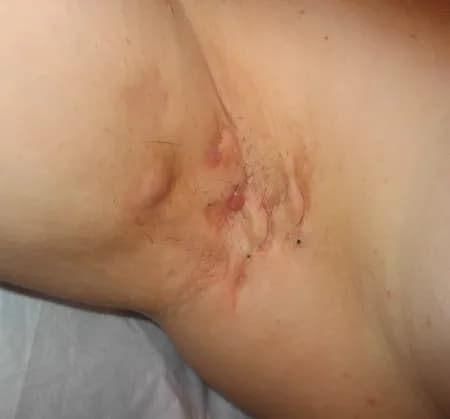
The short answer lies in the mechanism: the visible part of HS (swelling, discharge) is the surface tip of what is happening beneath the skin — blocked hair follicles, an inflammatory cascade, and, once established, tunnels (see the guide). No substance applied to the skin's surface reaches that depth in any meaningful amount; and even if it did, an established tunnel is a structural problem that does not close even with medication — the solution is a procedure. The ceiling of what herbal products can achieve is improving surface comfort. Read on with that ceiling in mind.
The green compartment: harmless supports
Warm compresses — not even an herb, but the champion of this list: a warm, moist compress on a tense swelling for 10 minutes several times a day softens the pain and helps a superficial abscess drain on its own. Aloe vera gel — can soothe irritated skin; if you choose a pure, fragrance-free form, the risk is low. It does not cure, it comforts — and that is something. Turmeric (curcumin) supplements — there is weak-to-moderate data that the oral form may reduce overall inflammatory tendency; I do not stand in the way of a patient who "wants to try it," but physician approval is essential for anyone on blood thinners. As for smearing turmeric paste on the skin, no benefit has been demonstrated — apart from a guaranteed yellow stain.
The yellow compartment: risky temptations
Tea tree oil is the internet's HS darling; its antiseptic effect is real, but here is the problem: the areas HS affects (armpits, groin, around the anus) are the body's most sensitive, most friction-prone skin, and essential oils are highly prone to causing irritation and allergic eczema there. Irritated skin becomes even more vulnerable to HS flares — so the good intention backfires. The same warning applies to lavender, eucalyptus, and "natural oil blends." If you must use them, the rules are: dilute generously, patch-test a small area on your forearm first, stop immediately at any redness. My recommendation: do not go near them at all.
The red compartment: the skin burners
This zone is non-negotiable. Binding on a garlic or onion poultice — the classic of folk remedies — causes chemical burns on delicate fold skin; anyone who has once seen a patient come in with a garlic burn never recommends that recipe again. Vinegar, lemon, baking soda applications belong to the same family: acid-base irritation leaves inflamed skin defenseless. Lancing a swelling with a needle, squeezing it, "ripening and popping" it — not herbal, but in the same folder: it spreads the infection deeper, accelerates tunneling, and increases scarring. And the general rule: no kitchen ingredient ever goes on an open, draining wound.
The invisible cost: lost months
The greatest harm of herbal experiments is usually not to the skin but to the calendar. HS is a progressive disease: as I explained in the staging article, the period of isolated lumps (stage 1) is the golden window for treatment. Six months spent on turmeric and oils can be enough for that window to close — for the tunnels to form. What should be done in those same six months is clear: diagnosis, staging, medication if needed, tackling smoking and weight, and smart home care. The herbal shelf is only innocent when it stays alongside this plan and confined to the green compartment.
Frequently asked questions
A honey-and-powder mixture worked for my neighbor; should I try it?
Most isolated "it worked" stories are applications that happened to coincide with a flare subsiding on its own — HS flares wax and wane even without treatment. If it is harmless (honey is relatively innocent), your only loss is time; but do not let it replace the plan.
I have used tea tree oil for years without a problem; can I continue?
If you have never had irritation, you are in the lucky group; I would not veto it, provided it is low-concentration and applied to intact skin. But do not apply it to open wounds or draining areas, and remember it is not a treatment.
Has no one ever recovered with purely natural treatment?
Mild, stage 1 disease sometimes enters long remission with lifestyle changes (smoking, weight, friction management) — the hero there is not the herb but those changes. Tunneled disease closing "the natural way," however, is something that simply has not been seen.
I use herbal products; should I mention it at my examination?
Absolutely — both to interpret your skin findings correctly and to manage drug interactions (especially turmeric with blood thinners). You will not be judged; on the contrary, we build the plan around your real life.
Sources
- American Academy of Dermatology (AAD) — Hidradenitis Suppurativa, aad.org
- NHS — Hidradenitis suppurativa, nhs.uk
Give your months to a plan, not a shelf — let us start with the right diagnosis: 444 8 623, Levent.
Content owner: Yasir Gozu, MD
Published: April 21, 2026
Last updated: July 8, 2026