This article is for information purposes only; it is not a substitute for an examination and a physician’s assessment.
Rectal prolapse is relatively common in children aged 1-4 and, unlike in adults, is mostly benign: it resolves on its own with growth. The trigger is usually constipation, bouts of diarrhea, or long sits on the toilet. First aid at home: stay calm, gently guide the tissue back in with a clean, moist cloth, resolve the constipation, shorten toilet time. Every child needs a physician's evaluation; in recurrent prolapse, cystic fibrosis testing is a standard step. Surgery is reserved only for the stubborn, recurrent minority.
The voice on the phone always starts with the same sentence: "Doctor, something came out of my child's bottom, we were terrified." At that moment my first job is not to make a diagnosis but to lower the pulse — because childhood rectal prolapse is the disease of the gulf between how frightening it looks and how innocent its course is: the sight alarms, the outcome usually reassures. This guide was written for the parent on that phone call.
Why does it happen in children?
In a small child, the rectum's suspension system is still under construction: the supporting tissues are loose, the curve of the tailbone is flat, and the bowel is relatively mobile. On this ground, two triggers are enough: straining (constipation or the long sits of the toilet-training period) and bouts that wear down the bowel (prolonged diarrhea, badly weathered infections, certain parasitic conditions). In children who are run-down and failing to gain weight, the lack of supporting fat tissue also contributes. So the prolapse is usually not "a disease" but a temporary weakness of immature anatomy — growth is the most powerful treatment.
What to do in the moment? First aid at home
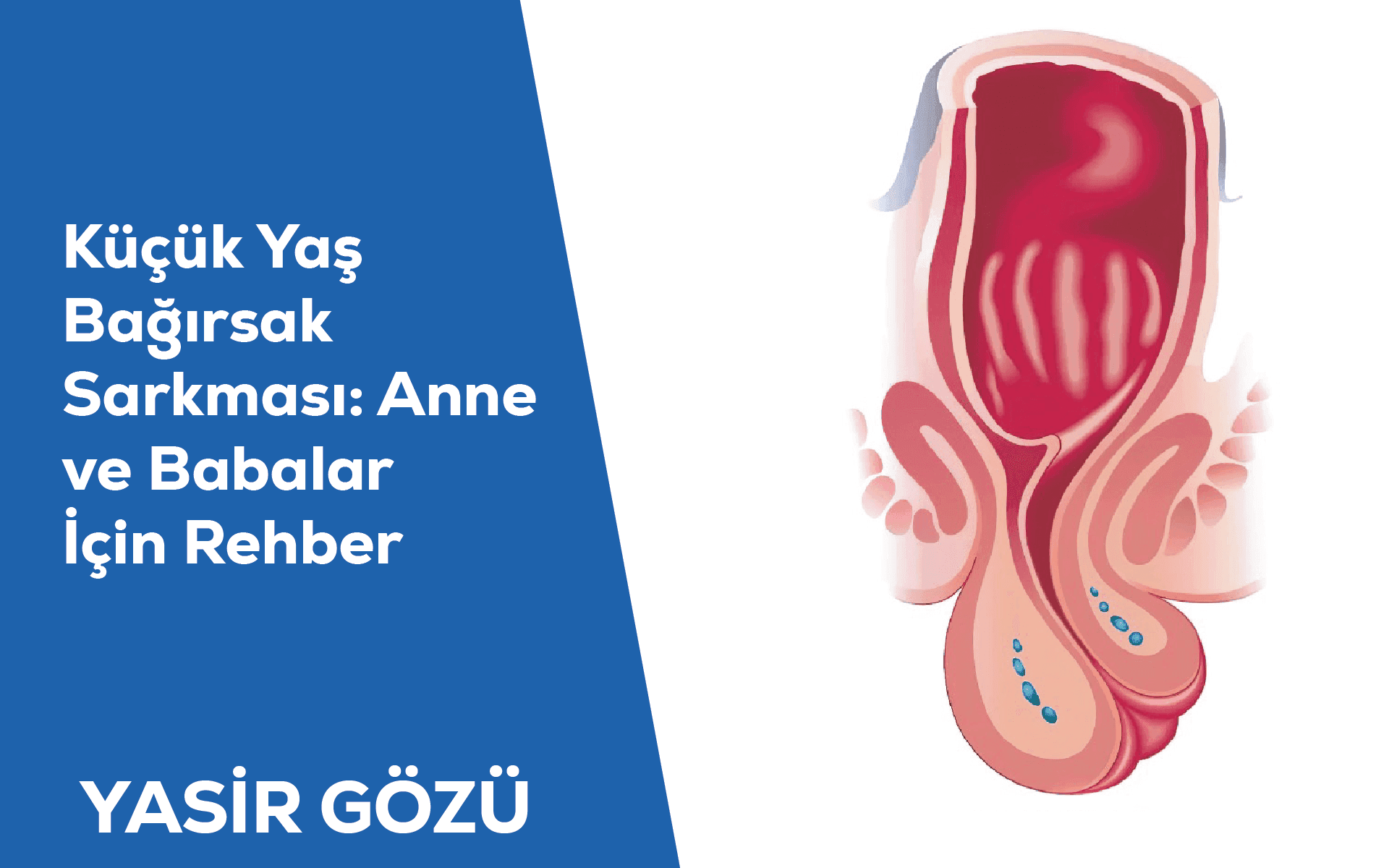
Step by step: 1) Stay calm — your panic transfers to the child and increases the clenching. 2) Look: if the tissue is pink-red, moist, and ring-patterned, it is a typical prolapse; it usually goes back in on its own once the bowel movement ends. 3) If it hasn't gone back: wash your hands, and with a clean, soft cloth or gauze moistened with lukewarm water, guide the tissue inward gently and without rushing — it usually slides in easily. Laying the child face down or with knees drawn to the chest makes it easier. 4) If it has gone back in: no need to panic, but book an appointment — a first prolapse should always be seen by a physician once. 5) If it won't go back, has turned purple, or the child is in severe pain: go to the emergency department without delay — this is a rare but real entrapment picture.
The real treatment: removing the trigger
More important than dealing with the prolapse itself is closing the loop that triggers it. Constipation management: plenty of age-appropriate fiber (prunes, pears, apricots — the kitchen from the children's fissure article applies here too), enough fluids, and if needed a softener recommended by the pediatrician; the goal is a strain-free stool. Toilet time: the 5-minute rule — the child should not linger on the toilet or potty; feet resting fully on the floor or a step reduces straining. Diarrhea bouts: for prolonged diarrhea, a physician's evaluation (stool testing if needed — including for parasites). When this trio is applied properly, the great majority of prolapses become less frequent month by month and disappear.
If it keeps recurring: two important doors
First door — cystic fibrosis testing: a little-known but standard rule: in stubborn, recurrent childhood prolapse, a sweat test is done, because rectal prolapse can be one of the early signs of cystic fibrosis. I write this not to frighten but so it is not missed — a normal test result is valuable information too. Second door — interventional treatment: in cases that keep recurring despite the routine and stretch into school age, small interventions (such as sclerotherapy) and, rarely, surgical fixation come onto the agenda together with pediatric surgery. Let me stress: this is the path of a small minority — in childhood prolapse, the knife is the exception.
When to see a physician? A clear list
At every first prolapse (no urgency, but an appointment is a must); if the prolapse is becoming more frequent or harder to push back in; if there is bruising or bleeding of the tissue, or the child is in severe pain (emergency); if failure to gain weight, greasy loose stools, or recurrent lung infections accompany it (cystic fibrosis workup); and if blood is seen in the stool (a separate article — in a child, too, it should be seen once). The examination is gentle; usually a history plus a brief look is enough.
Frequently asked questions
Does the prolapse hurt my child?
Usually less than you would think — children generally feel strangeness more than pain. Severe pain plus bruising, however, is a sign of entrapment and is an emergency.
Could I do harm while pushing it back in?
Not as long as you are gentle — the tissue is resilient. Do not force it; use a moist cloth for lubrication; if it will not go in, seek care rather than persisting.
If I fasten the diaper tightly, will that stop it from coming out?
No, and do not try — the pressure irritates and does not prevent the protrusion. The solution is not mechanical but trigger management: soft stools + short toilet time.
Will it fully go away with growth, and will it leave a trace?
In the typical course, it disappears completely around ages 4-5 and leaves no trace — no functional or permanent problem remains. No link to adult prolapse (see the guide) has been shown either.
Sources
- American Society of Colon and Rectal Surgeons (ASCRS), fascrs.org
- NHS — Rectal prolapse, nhs.uk
Clarifying your child's picture and putting your mind at ease is a single-visit job: 444 8 623, Levent.
Content owner: Yasir Gozu, MD
Published: September 3, 2024
Last updated: July 8, 2026