The medical information in this article was written by Yasir Gozu, MD (General Surgery Specialist) and checked against current medical sources.
This article is for information purposes only; it is not a substitute for an examination and a physician’s assessment.
Rectal prolapse is the last part of the bowel sliding over itself and protruding out of the anus. The easiest identifying sign: the protruding tissue appears as concentric rings (prolapsing hemorrhoids, by contrast, form separate soft lumps). It has two peak ages: young children (most resolve on their own) and older age; especially women who have had multiple births. The underlying ground is pelvic floor weakness and chronic straining. In adults, the lasting solution for full-thickness prolapse is surgery; the approach (abdominal or through the anus) is chosen to fit the patient.
Among the patients who come to my office saying "my hemorrhoids have prolapsed", in a proportion of them I see a completely different picture in the first second of inspection: the tissue emerging from the anus is not the soft lumps of hemorrhoids; it is the end of the bowel, arranged in regular, concentric rings. Rectal prolapse. It is little known, much confused and (most importantly) it does not improve with hemorrhoid treatment. In this article we will get to know the disease: who gets it, why, how it is distinguished from hemorrhoids, and how it is repaired.
What exactly is prolapse?
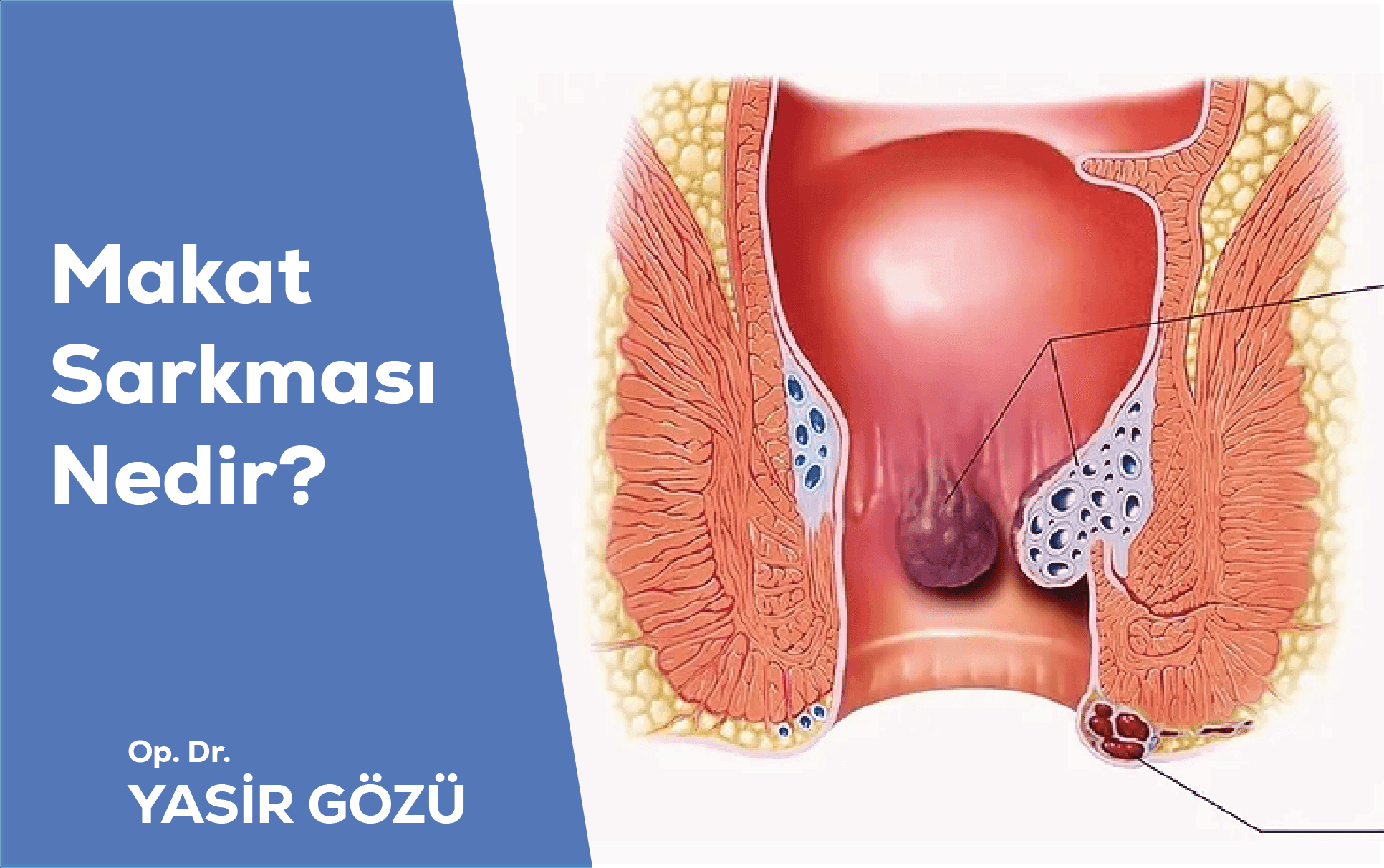
The last part of the bowel (the rectum) hangs suspended inside the pelvis by ligaments and muscles. When this suspension system weakens, the bowel folds into itself and slides like a telescope; first internally (internal prolapse / intussusception), and as it progresses, it spills out through the anus. It has three levels: internal prolapse (invisible from outside; it announces itself with a sense of incomplete emptying and obstructed defecation), mucosal prolapse (only the inner lining layer protrudes; limited, short protrusion), full-thickness prolapse (the entire bowel wall is outside; the classic ring-patterned picture). The level determines the treatment decision.
Who gets it? A tale of two peaks
The disease's age curve is interesting: it has two peaks. The first peak, children aged 1-4: pelvic support tissues not yet mature and spells of constipation or diarrhea; fortunately, most childhood prolapse resolves by itself with growth (guide for parents). The second peak, older age; predominantly women: a pelvic floor worn by multiple, difficult births, tissue laxity that comes with menopause, and decades of accumulated constipation and straining (older-age article). It is rarer in men and in young adults; when seen, chronic straining and pelvic floor problems are looked into.
Symptoms: The sum of four complaints
1) Tissue coming out: at first it emerges only with bowel movements and goes back in by itself or with the hand; as it progresses, it starts to emerge with coughing, walking, standing. 2) Wetness and mucus: the bowel lining outside keeps producing secretions; constant wetness and staining in the underwear, skin irritation. 3) Incontinence: because the prolapsing bowel keeps the muscle ring stretched, weakened control of gas and stool is common; it is the finding patients hide most and the one that most damages quality of life. 4) Incomplete emptying and bleeding: the prolapsed tissue acts as a plug; its surface can bleed with irritation. Any combination of these four warrants an examination; and the examination is usually enough for the diagnosis (defecography, imaging of the act of defecation, is added if needed).
Hemorrhoid or prolapse? The distinction at a glance
| Rectal prolapse | Prolapsing internal hemorrhoids | |
|---|---|---|
| Appearance | Concentric RINGS (like a fingerprint) | Separate soft lumps (like leaf segments) |
| Size | Usually larger, symmetrical | Smaller, one by one |
| Wetness/mucus | Marked and constant | Little |
| Incontinence | Frequently present | Rare |
| Treatment | Surgery (suspension/resection) | Stage-based: lifestyle first, then laser, classic surgery if needed |
The distinction is critical because the treatments are completely different: applying hemorrhoid cream to a prolapse is wasted time, and performing hemorrhoid surgery on a prolapse is the wrong operation. I covered every candidate for tissue protruding from the anus, one by one, in the differential article.
Treatment: The honest frame
Let me be clear from the outset: full-thickness prolapse in an adult has never been seen to resolve with creams, exercises or waiting: the suspension system has given way, and its repair is surgical. There are two main roads. The abdominal route (rectopexy): the bowel is re-suspended to the pelvis; nowadays mostly by the keyhole (laparoscopic) method; it has the lowest recurrence and is the first choice in patients fit for it. The anal route (perineal approaches): the prolapsed segment is corrected or removed through the anus; a valuable, gentler option for the very elderly and those with comorbidities who could not tolerate abdominal surgery, but with somewhat higher recurrence. The choice is personalized by age, comorbidities, the size of the prolapse and the state of continence (detailed in the older-age article). For mucosal, limited prolapse and an accompanying hemorrhoidal component, laser-assisted methods can come into play; with their limits stated.
Until surgery: Keeping the picture from worsening
Until surgery is scheduled, three things are done: resolving constipation (fiber, water and a softener if needed; every strain enlarges the prolapse), gently returning the protruding tissue inside and keeping it dry (reduces irritation and bleeding), and knowing the strangulation emergency: if tissue stuck outside will not go back in, is turning purple and the pain is rapidly worsening, that is strangulation; seek care the same day, without delay.
Frequently asked questions
Does prolapse resolve on its own?
In children, mostly yes; in adults, no; as long as gravity and straining continue, the picture progresses over the years. Early surgery means both a smaller operation and a better result.
Do Kegel exercises help?
They do not reverse an established full-thickness prolapse; but they are valuable for supporting pelvic floor strength and continence control before and after surgery. In other words, not a treatment, but a treatment's helper.
Does the incontinence improve after surgery?
In most patients it improves markedly over time; the prolapsing tissue no longer stretches the muscle ring. In long-standing, severe incontinence the improvement may remain partial; which is one more reason to act early.
Can this disease turn into cancer?
Prolapse itself is not cancer and does not turn into cancer. However, evaluating the inside of the bowel once (by colonoscopy) is standard at the diagnostic stage; to rule out any other pathology accompanying the prolapse.
Sources
- American Society of Colon and Rectal Surgeons (ASCRS) — Clinical Practice Guidelines for Rectal Prolapse, fascrs.org
- Turkish Society of Colon and Rectal Surgery, tkrcd.org.tr
Let us establish the type of your prolapse and the repair that suits you: +90 552 608 39 21, Levent.
Yasir Gozu, MD
General Surgery Specialist
He has worked in anorectal diseases (proctology) for over twenty years, focusing on non-surgical laser treatments for hemorrhoids, anal fistula, anal fissure and pilonidal sinus. He sees patients at Avrupa Cerrahi in Besiktas Levent.
Content owner: Yasir Gozu, MD
Published: April 9, 2026
Last updated: September 9, 2026