The medical information in this article was written by Yasir Gozu, MD (General Surgery Specialist) and checked against current medical sources.
This article is for information purposes only; it is not a substitute for an examination and a physician’s assessment.
An anal fissure is a small tear at the outlet of the anal canal; its signature is knife-like pain during bowel movements plus a small amount of bright red blood on the paper. A fresh (acute) fissure mostly heals on its own within 4-6 weeks with the fiber-water-sitz-bath trio. What blocks healing is the vicious cycle: pain tightens the muscle, the spasm reduces blood flow, and the poorly supplied wound cannot close. A fissure lasting beyond 6-8 weeks has become chronic; creams, muscle-relaxant injection and the laser/surgery steps then come into play.
The anal fissure is the diagnosis in my practice that patients most often "arrive frightened by and leave relieved about." The fear is understandable: that sharp, knife-stab pain during bowel movements and the blood on the paper bring the worst scenarios to mind. The reality, most of the time, is this: a tear of a few millimeters at the outlet of the anal canal; technically called an anal fissure. It is small, but because of where it sits, it makes a lot of noise. And its most important trait is this: managed correctly, it is a wound that usually heals by itself; managed poorly, it is a wound that drags on for months.
What is an anal fissure, and where does it form?
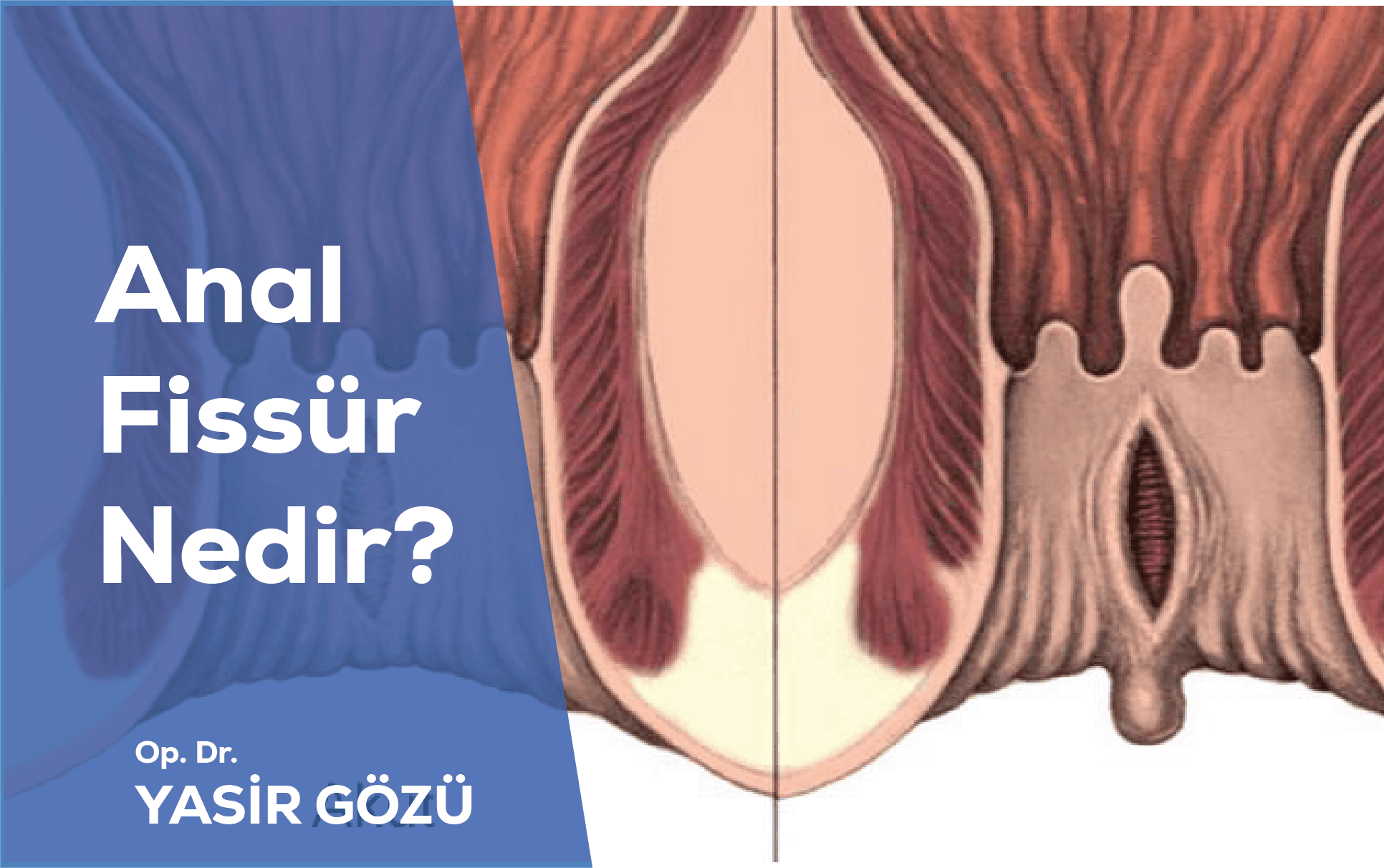
The final, skin-adjacent segment of the anal canal is a sensitive, nerve-rich area. The forced passage of hard stool (sometimes severe diarrhea or childbirth) opens a fine tear here. The great majority of tears sit on the posterior midline (toward the tailbone); some sit on the anterior midline. Knowing the location is not trivial: fissures off the midline raise suspicion of underlying conditions (such as Crohn's disease) and are evaluated more carefully.
The real issue: The vicious cycle
Like every wound in the body, a fissure wants to close. So why does it sometimes stay open for months? The answer is the fissure's notorious vicious cycle, and it is the key to understanding this disease: Pain reflexively tightens (spasms) the internal muscle ring around the anus. The tightened muscle restricts blood flow to the area. A wound starved of blood cannot heal: and with every bowel movement it tears open again and hurts again. The cycle feeds itself. Every fissure treatment (from warm baths to muscle-relaxant injection, from creams to surgery) has one shared goal: breaking this cycle at some point.
Symptoms: The signature trio
Sharp, burning-stabbing pain during bowel movements; then burning and aching that lasts minutes to hours; and a small amount of bright red blood on the paper. This trio is the fissure's signature; it distinguishes it from the painless bleeding of hemorrhoids and the discharge of a fistula. A small skin bump (a sentinel tag) may develop at the edge of a chronic fissure; patients often mistake it for a hemorrhoid. I cover the full range of symptoms in depth in a separate article.
Acute or chronic? The 6-8 week line
Time decides a fissure's fate. An acute fissure (the first 6-8 weeks): a superficial, fresh tear; the chance of healing with conservative care is high. A chronic fissure (beyond 6-8 weeks): the base of the wound turns whitish (exposed muscle fibers), the edges thicken, and a sentinel tag appears. This is no longer a "fresh wound" but a "dried-out, poorly healing wound"; the chance of spontaneous healing drops noticeably and the treatment step rises. That is why six weeks of complaints is the critical threshold for getting examined.
What causes it?
The chief cause, by a wide margin, is constipation: the tear opened by hard stool is the classic start of the disease (the relationship is detailed in this article). It is followed by bouts of severe diarrhea, childbirth (especially difficult deliveries), prolonged sitting, and mechanical strain on the anal area. More rarely it occurs against a background of inflammatory bowel disease. It is most common in young and middle-aged adults; it is not at all rare in children either.
Home care: The engine of healing
In an acute fissure, the foundation of treatment is not medication but routine. Warm sitz baths: the fissure's number-one friend: 10-15 minutes, 2-3 times a day and after every bowel movement; by relaxing the muscle spasm and increasing blood flow, they break the cycle right at its heart. Softening the stool: 25-30 grams of fiber a day, 2 liters of water, a stool softener if needed; every hard stool is a fresh scalpel to the wound. Toilet discipline: go without delaying, do not strain, do not linger on the toilet. Gentle hygiene: cleaning with water, patting dry without pressing. Daily life and diet are covered in full in the "what to do" guide, and pain management in the pain article.
How is it diagnosed?
In most patients, the history plus a gentle inspection is enough; a typically located fissure is visible to the eye. The examination is done manually and, when needed, supported by instruments; in the painful acute phase it is kept as gentle and brief as possible. So the fear that "the examination will hurt terribly" is largely unfounded with fissures. For off-midline, multiple, or atypical fissures, further evaluation is planned to look for an underlying cause.
The treatment ladder: Step by step
Step 1; the conservative routine (the protocol above): most acute fissures heal here. Step 2; prescription creams: muscle-relaxing topicals (containing a calcium channel blocker or a nitrate) chemically release the spasm; they are used in 6-8 week courses. With a doctor's prescription; over-the-counter hemorrhoid creams are not a solution for fissures. Step 3; muscle-relaxant injection: injected in a small dose into the internal muscle ring, it breaks the spasm for 2-3 months and opens a healing window for the wound; same-day, no incision. Step 4: laser and surgery: in a resistant chronic fissure, a minor procedure (LIS or laser-assisted approaches) releases the spasm permanently; in a well-selected patient, success is very high. Everything before and after surgery is in the surgery guide.
When to see a doctor?
Do not put off an examination in these situations: if your complaints have lasted more than 3-4 weeks (before chronicity approaches), if the bleeding keeps recurring (even if your fissure guess is correct, have it confirmed once; especially over age 40), if the pain is unbearable (suffering through it is pointless when rapid relief with muscle-relaxant injection is possible), and if fever and swelling have joined in (an abscess must be ruled out).
Frequently asked questions
Does an anal fissure heal on its own?
Most acute (fresh) fissures heal in 4-6 weeks if the constipation is resolved and the bath routine is followed. In a chronic fissure that chance drops noticeably; stepwise treatment is needed.
Can a fissure turn into hemorrhoids?
No; they are different diseases. The confusion comes from the sentinel tag at the edge of a chronic fissure being mistaken for a hemorrhoid.
How much bleeding is normal?
Fissure bleeding is typically small in amount: a trace on the paper, a streak on the stool. Heavy, dripping, or dark bleeding is not the language of a fissure; it must be evaluated separately.
If I have surgery, will I leak gas?
Even with the classic techniques where this risk is discussed, the rate is low in experienced hands; modern approaches focus on preserving the muscle. The risks and the facts are laid out honestly in the surgery guide.
I am pregnant and have a fissure; what should I do?
Fissures are common in pregnancy and can be managed safely; see the pregnancy article for the protocol and medication rules.
Sources
- American Society of Colon and Rectal Surgeons (ASCRS) — Clinical Practice Guideline for Anal Fissure, fascrs.org
- NHS — Anal fissure patient information, nhs.uk
- Turkish Society of Colon and Rectal Surgery, tkrcd.org.tr
Do not get used to pain that has lasted six weeks; the cycle can be broken: +90 552 608 39 21, Levent.
Yasir Gozu, MD
General Surgery Specialist
He has worked in anorectal diseases (proctology) for over twenty years, focusing on non-surgical laser treatments for hemorrhoids, anal fistula, anal fissure and pilonidal sinus. He sees patients at Avrupa Cerrahi in Besiktas Levent.
Content owner: Yasir Gozu, MD
Published: May 4, 2026
Last updated: September 9, 2026