The medical information in this article was written by Yasir Gozu, MD (General Surgery Specialist) and checked against current medical sources.
This article is for information purposes only; it is not a substitute for an examination and a physician’s assessment.
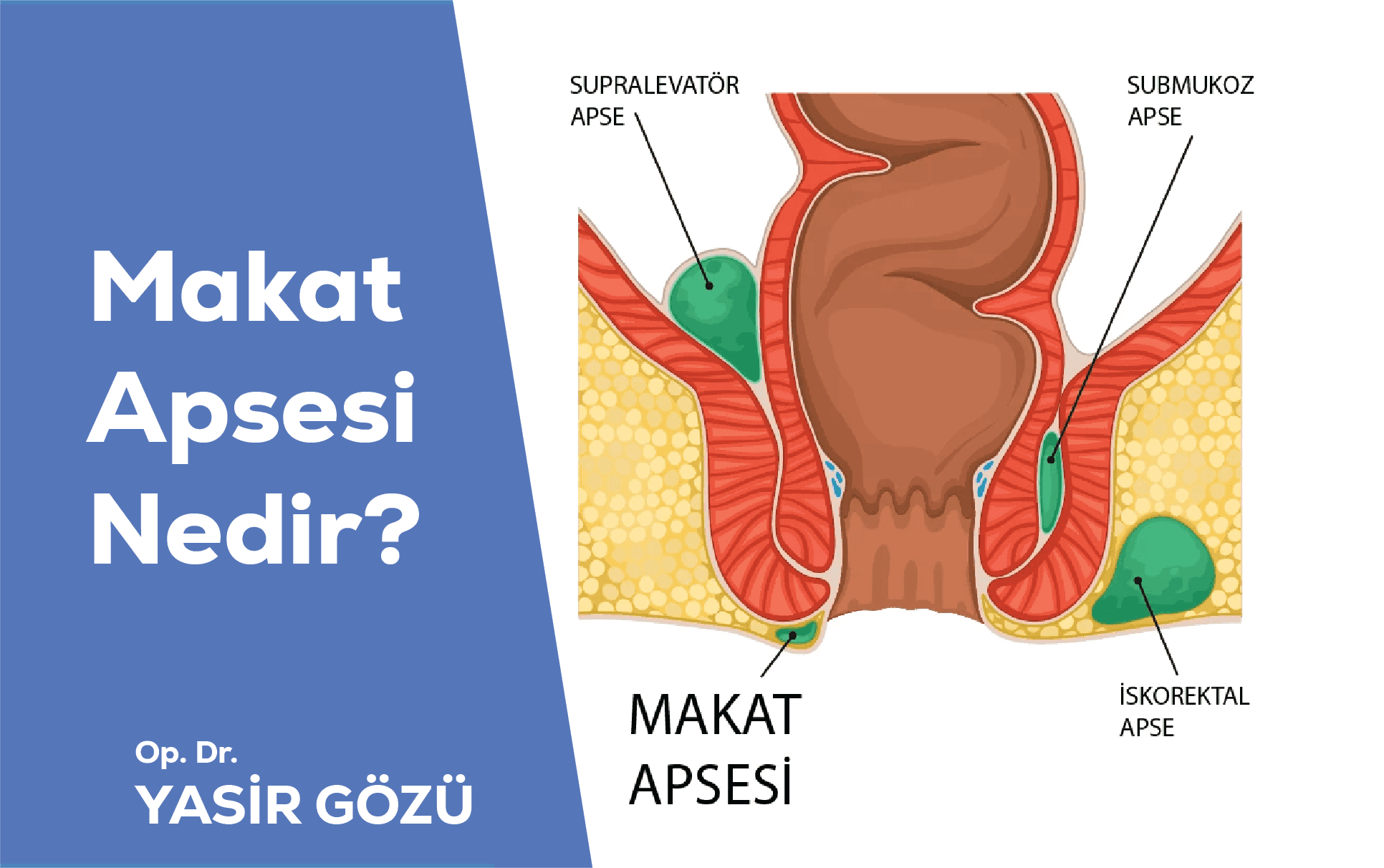
A perianal abscess is a pocket of pus that collects under the skin when the small glands of the anal canal become blocked and infected. Its signature: throbbing, sit-preventing, steadily worsening pain around the anus and a tense swelling, sometimes fever. The only real treatment is drainage: evacuating the pus; antibiotics alone cannot dissolve an abscess, and squeezing or bursting it spreads the infection deeper. After drainage, a proportion of patients develop an anal fistula; that is why an abscess ends not with drainage but with follow-up.
The perianal abscess is a classic of the surgical night shift: midnight, a patient drenched in sweat who cannot sit down... By then, two or three days have usually passed since the pain began; someone said "it will pass", a hot water bottle was applied, antibiotics were bought from the pharmacy. It did not pass; because a perianal abscess is, by its nature, a condition that does not pass. In this article I will explain what an abscess is, why pills cannot melt it, and what awaits you after the intervention; without hiding the fistula issue.
How does an abscess form? The story of a blocked gland
Inside the anal canal there are small glands that produce secretions to lubricate bowel movements. The mouth of one of these glands can become blocked; just as with a pimple. Inside the blocked gland, bacteria multiply, pus accumulates, and as the pressure rises the pus carves out a pocket into the surrounding soft tissue: that is the abscess. If the pocket forms near the skin, it produces a visible red swelling; if it forms in the deep planes, it may run its course with nothing visible from the outside: only deep pain and fever; the most insidious scenario, which I will return to shortly. The detailed mechanism and risk factors are in the causes article.
Why does "waiting" not work?
We are used to the body extinguishing many infections on its own; why does that expectation fail with an abscess? Because an abscess is a pressure chamber with sealed walls: neither immune cells nor antibiotics carried in the bloodstream can adequately reach the pus inside. The pressure rises with every hour; the "throbbing" character of the pain is precisely that pressure pulsing with your heartbeat. An abscess left to wait goes down one of three roads: it bursts through the skin on its own (an uncontrolled and usually incomplete emptying), it expands deeper (requiring bigger surgery), or (rarely) it progresses to widespread infection. All three are worse than a small drainage done on time.
The only real treatment: Drainage
The rule is clear and has not changed in a hundred years: if pus has collected, it is drained. Drainage means evacuating the pus through a small opening over the abscess; superficial abscesses can be drained under local anesthesia in office conditions, deep or large ones in the operating room under brief anesthesia (the types are detailed in the treatment types article). What surprises patients most is how fast the relief comes: the moment the pressure is released, the throbbing stops; the patient who has not slept for days sleeps that night. The role of antibiotics is supportive: they are added to drainage to contain infection spreading into the surrounding tissue; they never replace it. Every day lost to "let's dissolve it with antibiotics" is a day the abscess grows.
The honest part: The abscess is drained, is it over?
Here is the truth most patients never hear: a significant proportion of perianal abscesses turn into an anal fistula after drainage. Remember the logic: the source of the abscess is the blocked gland inside the canal; drainage empties the pus, but the path opened between the gland and the skin sometimes fails to close; it settles in as a permanent tunnel, that is, a fistula. This is not a failure of the drainage; it is the nature of the disease. The practical consequence: abscess treatment ends not with drainage but with follow-up; if the discharge does not stop during recovery, or the swelling recurs in the same spot, that signals a developing fistula and puts the fistula treatment plan on the table. The patient who knows this from the start does not panic if it happens; the one who does not know assumes "the operation failed".
The deep abscess trap: Invisible from the outside
A proportion of abscesses form deep between the muscle planes; from the outside, no redness, no swelling: only steadily worsening deep anal pain, difficulty sitting, and usually fever and fatigue. This picture lends itself all too well to weeks of stalling with hemorrhoid cream because "nothing is visible outside". My rule is this: worsening deep anal pain and fever, even without any visible finding = abscess until proven otherwise. The diagnosis is made by examination and, if needed, imaging (MRI). The full map of symptoms is in the symptoms article.
When is it an emergency?
Any one of these three cannot wait until "tomorrow": fever above 38°C with chills (a sign the infection is crossing its boundaries), a swelling that is growing and hardening within hours with spreading redness, and any suspicion of a perianal abscess in a patient with diabetes or a suppressed immune system (in this group the picture can deteriorate rapidly). Seek care even if it is the middle of the night; an abscess does not keep office hours.
Frequently asked questions
My abscess burst on its own and I felt relief; do I still need a doctor?
Yes; spontaneous rupture is usually incomplete emptying: the pocket is not fully cleared and can refill; the fistula risk also remains unchanged. Even if you feel better, get examined.
Will a warm sitz bath cure the abscess?
No; it can sometimes ripen very early, very superficial collections and ease their emptying, but the rule stands: the solution for an established, throbbing abscess is drainage. The bath is a valuable part of care after drainage.
Is drainage very painful?
The procedure is done under anesthesia (local or brief general); what you feel is the first sting of the needle. And remember: the pain after the procedure is always less than the pain of the abscess; the pressure is gone.
Does every abscess become a fistula?
No; a proportion heal without a trace. But a meaningful proportion do fistulize; rather than guessing the odds, the right approach is follow-up: if the discharge has not stopped by 4-6 weeks, or the swelling recurs, a fistula evaluation is done.
Sources
- American Society of Colon and Rectal Surgeons (ASCRS) — Clinical Practice Guidelines for Anorectal Abscess, fascrs.org
- Turkish Society of Colon and Rectal Surgery, tkrcd.org.tr
Let us resolve the throbbing pain before it grows; for a same-day evaluation: +90 552 608 39 21, Levent.
Yasir Gozu, MD
General Surgery Specialist
He has worked in anorectal diseases (proctology) for over twenty years, focusing on non-surgical laser treatments for hemorrhoids, anal fistula, anal fissure and pilonidal sinus. He sees patients at Avrupa Cerrahi in Besiktas Levent.
Content owner: Yasir Gozu, MD
Published: April 9, 2026
Last updated: September 9, 2026