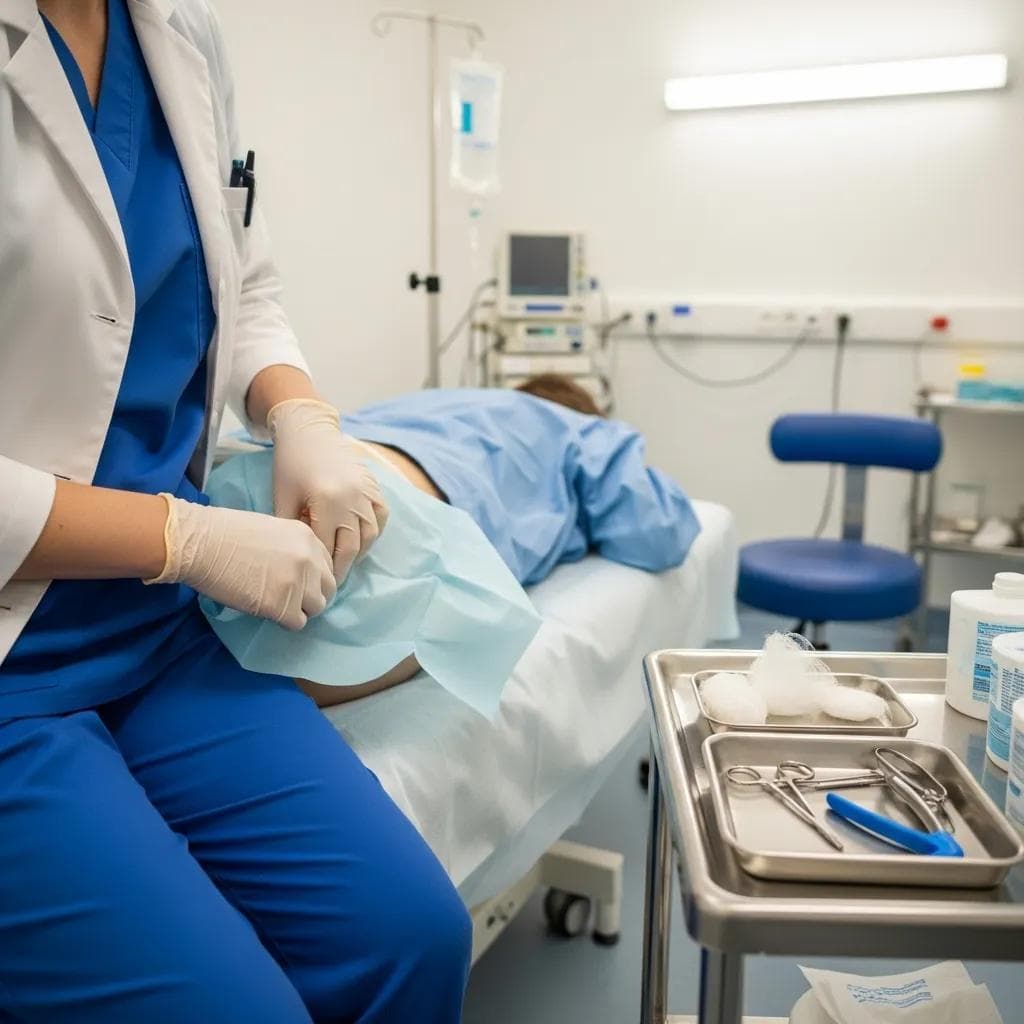
The medical information in this article was written by Yasir Gozu, MD (General Surgery Specialist) and checked against current medical sources.
This article is for information purposes only; it is not a substitute for an examination and a physician’s assessment.
An anal fistula is a tunnel between the bowel and the skin around the anus that does not close on its own. It almost always develops in the wake of a previous abscess. Treatment is always procedural; superficial fistulas are nowadays mostly treated with laser, incision-free and as a day procedure.
I always explain anal fistula to my patients with the same analogy: a thin tunnel that should not exist, running between the last part of the bowel and the skin around the anus. One mouth of this tunnel is inside the bowel, the other on the skin. And from time to time, pus seeps through it. It sounds like a small thing; and it is precisely this "small" appearance that keeps patients struggling for months.
How does a fistula form?
The story almost always starts the same way. Inside the anal canal there are small glands that produce secretions. If one of them becomes blocked and infected, an abscess develops: that throbbing swelling that will not let you sit and keeps you up at night. The abscess either bursts on its own or is drained by a physician, and the patient breathes a deep sigh of relief; the pain is gone.
But here is the invisible part: as the pus drains out, it leaves a track behind. In roughly half of cases this track does not close; its inner surface becomes lined over time with skin-like tissue and it becomes permanent. Its name is now an anal fistula. This is why I see some of the patients who rejoiced with "my abscess burst, I'm free" back in my office a few months later.
Who gets it more often?
We encounter it most often in men between 30 and 50; it is rarer in women. Inflammatory bowel diseases such as Crohn's disease, diabetes, immunosuppressive treatments, and previous surgery in the anal region increase the risk. But let me add this: most of my patients have none of these risks; just an unlucky abscess story. I covered the triggers at length in a separate article.
Is every fistula the same?
No; and this is exactly what determines the treatment. Where does the tunnel pass through the muscular ring (the sphincter) that keeps the anus closed; the entire mathematics of the matter lies in that question. Superficial fistulas involving only a small part of the muscle and fistulas that cross it entirely or have branched require completely different plans. That is why we sometimes order an MRI at the examination; choosing a method without seeing the tunnel's map is like setting out without knowing the address. You can find the stages and the treatment for each in this comprehensive guide.
How is it recognized?
Three signs stand out: recurrent discharge that stains the underwear, a dull ache that worsens with sitting, and a small hole in the skin that will not close. The symptoms disappear from time to time; that is silence, not healing. I listed everything, including the ways it gets confused with hemorrhoids, in the symptoms article.
Is there a treatment?
There is; and it is more comfortable than you think. One hard truth: a fistula does not heal with medication or creams; the tunnel must be closed. For superficial fistulas this is now mostly handled with laser, incision-free and as a day procedure; patients usually return to work the next day. For complex fistulas, muscle-sparing surgical techniques come into play. I compared the options on the treatment page.
Frequently asked questions
Does a fistula close on its own?
No. Because the tunnel's inner surface is lined with skin-like tissue, the body does not see it as a "wound" and does not try to heal it. Quiet periods are not closure.
Is a fistula contagious?
No. It does not pass from person to person; it is not the result of poor hygiene or contact.
Are a fistula and piles the same thing?
No. Piles are the enlargement of vascular cushions, while a fistula is an infected tunnel. Their symptoms can overlap; you can read about the differences here.
What happens if I don't get treated?
The tunnel can branch, abscesses recur, and treatment becomes progressively harder. For details, see "Is an anal fistula dangerous?".
If you have any suspicion, the examination takes a few minutes and you gain clarity that same day. You can reach our clinic in Levent at 444 8 623.
References
- American Society of Colon and Rectal Surgeons (ASCRS), fascrs.org
- NHS — Anal Fistula patient information, nhs.uk
- Turkish Society of Colon and Rectal Surgery, tkrcd.org.tr
Yasir Gozu, MD
General Surgery Specialist
He has worked in anorectal diseases (proctology) for over twenty years, focusing on non-surgical laser treatments for hemorrhoids, anal fistula, anal fissure and pilonidal sinus. He sees patients at Avrupa Cerrahi in Besiktas Levent.
Content owner: Yasir Gozu, MD
Published: May 9, 2024
Last updated: September 9, 2026