The medical information in this article was written by Yasir Gozu, MD (General Surgery Specialist) and checked against current medical sources.
This article is for information purposes only; it is not a substitute for an examination and a physician’s assessment.
In most cases, an external hemorrhoid swelling subsides on its own within 1-3 weeks; warm sitz baths, a soft-stool routine, and correct sitting habits make the process noticeably more comfortable. If the swelling is purple, firm, and within the first 72 hours, it may be clotted (thrombosed); in this window, a small in-clinic procedure can end the pain the same day. Trying to pop, lance, or push the swelling back in is the most common and most costly mistake.
The phone description of this complaint is almost always the same: "I noticed a swelling last night, it hurts when I touch it; is it a pile, or something bad?" Let me reassure you first: the most common cause of a suddenly appearing painful swelling at the edge of the anus is an external hemorrhoid, and the great majority subside with treatment or on their own. But I would ask you to read this article to the end, because this same swelling has an "emergency relief window," and most patients suffer weeks of unnecessary pain because they do not know about it.
What is an external hemorrhoid, and why does a pile swell?
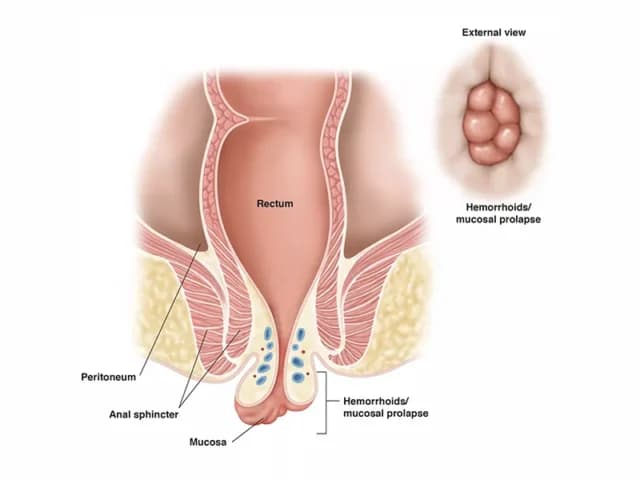
At the exit of the anal canal, under the skin, there are vascular cushions. Straining with constipation, long sits on the toilet, heavy lifting, pregnancy, or sitting still for long periods raises the pressure in these cushions; the vessel dilates and a soft swelling you can feel from outside forms. This is the classic external hemorrhoid.
Sometimes the scenario is noisier: a clot forms inside the dilated vessel. The swelling grows within hours and becomes purple-blue, olive-hard, and very painful. This is called a thrombosed external hemorrhoid, and it is the most painful version of the picture people search for as a "swollen pile." It is not dangerous; but its first days are rough.
How long does it take to go away?
A simple external hemorrhoid swelling usually subsides within a few days to a week if the trigger (most often constipation) is corrected. With a thrombosed one, the timeline differs: pain peaks in the first 2-3 days, then the body slowly dissolves the clot and the swelling shrinks over 2-3 weeks; a small skin tag may sometimes remain. So the answer to "will it go away?" is usually yes; the real question is how comfortably you will get through the process.
The 72-hour window: The most important thing nobody knows
In a thrombosed external hemorrhoid, for a patient who comes in within the first 48-72 hours, we can provide same-day relief with a small procedure lasting a few minutes, done in the office under local anesthesia (evacuating the clot). Once this window closes, the benefit of the procedure diminishes; managing the process at home then becomes the right choice. If your swelling is very painful, firm, and new; do not wait; come in during the first days. This single piece of information is the most valuable sentence in this article.
7 home methods that work
1. Warm sitz baths: 2-3 times a day and after every bowel movement, 10-15 minutes, plain warm water. It relaxes the muscles and soothes the pain. 2. Brief cold application on day one: for a new and very swollen pile, a cold compress wrapped in a thin cloth, no longer than 10 minutes; it reduces edema (never place ice directly on skin). 3. Softening the stool: 25-30 grams of fiber a day, at least 2 liters of water; a stool softener from the pharmacy if needed. Every toilet visit with hard stool is a fresh blow to the swelling. 4. Toilet discipline: do not stay on the toilet longer than 5 minutes, leave the phone outside, do not strain. 5. Managing how you sit: break up long sits with short walks every hour; in a very painful period, lying on your side brings relief. 6. Gentle hygiene: wash with water after bowel movements, pat dry without pressing; stay away from perfumed wet wipes. 7. Pain relief: paracetamol is the first choice; avoid aspirin as it can increase bleeding tendency, and codeine-containing painkillers cause constipation; do not use them.
5 mistakes to avoid
I have heard all of them from my patients: popping the swelling with a needle (infection and uncontrolled bleeding; the most dangerous mistake), trying to push the firm swelling back inside (a thrombosed pile cannot be pushed in; it differs from a prolapsed INTERNAL hemorrhoid; if you cannot tell them apart, do not force it), searching for relief on the toilet for hours, stalling for months with a pharmacy cream (creams can help as support, but cortisone-containing ones must not be used longer than a week; use without a diagnosis masks the real problem), and following the internet and applying garlic, vinegar, or toothpaste to the area (I have seen patients come in with chemical burns).
When should you see a doctor?
Stop the home management in these situations: if the swelling is within the first 72 hours and very painful (let's use the window), if there is fever or spreading redness (an abscess must be ruled out), if bleeding keeps recurring; especially over age 40, a one-time examination is a must rather than assuming "it's just piles"; and if the swelling has not subsided in 3 weeks. The examination takes a few minutes and requires no preparation.
If it won't resolve at home: The lasting solution
With recurrent external hemorrhoids and permanent palpable piles, the problem is no longer the "swelling" but the dilated vascular structure itself; and that structure does not shrink with cream. Fortunately, a scalpel is not required for this job. Laser hemorrhoid treatment is incision-free and same-day in suitable cases; permanent skin tags can be corrected in the same session. The full range of options is on the hemorrhoid treatment page.
Frequently asked questions
What should I do if a swollen pile bursts on its own?
No panic: clean the area with warm water, place a clean pad, and come in for an examination if the bleeding continues or has not stopped by the next day. There is relief after a burst, but the underlying vessel problem stays in place.
Is the purple color a sign of something bad?
A purple-blue firm swelling typically indicates a clot (thrombosis); it looks alarming but is not dangerous. Its real significance is that it reminds you of the 72-hour window.
The swelling went down but a small tag remains; is that normal?
Yes, a small skin tag often remains after a thrombosis. It is not a health problem; if it interferes with hygiene or bothers you, it can be removed with a small procedure.
Which do I have: internal or external?
External ones can be felt and hurt; internal ones mostly bleed and prolapse outward in advanced stages. I explain the distinction in this article; the definitive answer belongs to the examination.
Should I use a cream?
It can be used as short-term (3-7 day) support; but which cream suits you depends on the diagnosis, and cortisone-containing products must not be prolonged. A cream is no substitute for a diagnosis.
Sources
- American Society of Colon and Rectal Surgeons (ASCRS) — Clinical Practice Guidelines for Hemorrhoids, fascrs.org
- NHS — Piles (Haemorrhoids) patient information, nhs.uk
If your swelling is new and very painful, call today; don't miss the 72-hour window: 444 8 623, Op. Dr. Yasir Gözü.
Yasir Gozu, MD
General Surgery Specialist
He has worked in anorectal diseases (proctology) for over twenty years, focusing on non-surgical laser treatments for hemorrhoids, anal fistula, anal fissure and pilonidal sinus. He sees patients at Avrupa Cerrahi in Besiktas Levent.
Content owner: Yasir Gozu, MD
Published: April 5, 2026
Last updated: September 8, 2026