The medical information in this article was written by Yasir Gozu, MD (General Surgery Specialist) and checked against current medical sources.
This article is for information purposes only; it is not a substitute for an examination and a physician’s assessment.
True hemorrhoids are rare in children; the most common cause of anal pain and bleeding is a constipation-related anal fissure. What "looks like a lump" is usually a skin fold, or, rarely, a rectal polyp. The foundation of treatment is resolving the constipation: fiber, water, and a toilet routine. A child with recurrent bleeding, a palpable mass, or a growing fear of bowel movements should always see a doctor.
The worried parent phone call is familiar in proctology too: "I saw blood on my child's diaper; could it be hemorrhoids?" First, take a breath: adult-type hemorrhoids are genuinely rare in children; a child's vascular cushions haven't spent years under the kind of pressure that builds up an adult system. But the blood is real, and so is the pain, and there's always an explanation. As a parent, what you need to know is that the explanation is usually more benign, and easier to treat, than you might think.
The most common cause of that blood in children: A fissure
By far the most common cause of bright red blood in a child's stool or on toilet paper is an anal fissure; a small tear caused by hard stool passing through. The clue is telling: the child cries during bowel movements, starts coding the toilet as a "bad event," and begins holding it in. Holding it in causes constipation, constipation worsens the fissure; that's the classic vicious cycle in childhood, and breaking that cycle is the key to treatment.
What if I see something that "looks like a lump"?
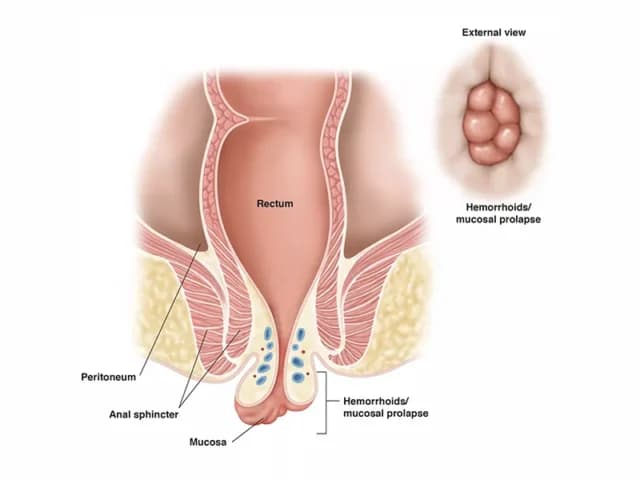
There are a few possibilities, and none of them should cause panic. A small sentinel skin tag forming at the edge of a fissure is common and harmless. If a pinkish tissue is described as coming out during a bowel movement and going back in, it may rarely be a rectal polyp or rectal prolapse (a protrusion of the rectal opening); both are conditions that need evaluation, but both are treatable. True hemorrhoids are at the very bottom of this list, and when they do occur, we usually look for another underlying cause.
First steps at home: Resolve the constipation
Before any medication, a child's anal complaint calls for changes in the kitchen and the bathroom: plenty of age-appropriate fiber (turn fruits and vegetables into a game; pears, plums, and apricots are good allies), enough water, meals eaten at the table instead of in front of a screen, and a toilet routine: a relaxed, unpressured 5-10 minutes after meals, with a footstool under their feet. A warm sitz bath is soothing for children too. Definitely avoid: applying adult hemorrhoid creams to a child, using suppositories or enemas on your own judgment, and turning bowel movements into a matter of punishment and reward (fear is constipation's best friend).
When should you see a doctor?
Don't delay an evaluation if: the bleeding recurs, there's a palpable mass or tissue coming out, the child isn't gaining weight or has poor appetite, a fear of bowel movements is taking hold, or the constipation doesn't respond to home measures within two to three weeks. The exam is gentle and brief; for our young patients, it's done in a parent's lap and made into a game. When needed, we work together with pediatric surgery or gastroenterology.
Frequently asked questions
Can infants get hemorrhoids?
Practically, no. Blood seen on a diaper is most often from a fissure, diaper-rash-related irritation, or something like cow's milk protein sensitivity; any bleeding in an infant should always be discussed with a doctor.
My child is holding in their bowel movements; what should I do?
The cause is usually a fear of pain; once we treat the fissure and the constipation, the fear usually resolves on its own. Forcing or scolding deepens the cycle; routine and praise work better.
Can my teenager have real hemorrhoids?
The likelihood rises in adolescence compared to childhood; especially with prolonged sitting, constipation, and weight training. The approach is similar to that for adults, but evaluation should still be done by a doctor.
What does dark-colored blood mean?
Dark blood, or blood mixed into the stool, suggests the source may be higher up, and it should always be investigated in children too. See a doctor without delay.
Sources
- NHS — Constipation in children / Piles, Constipation in children / Piles (haemorrhoids)
- American Society of Colon and Rectal Surgeons (ASCRS), fascrs.org
A gentle evaluation is all it takes to clarify what's going on with your child: 444 8 623 — Op. Dr. Yasir Gözü.
Yasir Gozu, MD
General Surgery Specialist
He has worked in anorectal diseases (proctology) for over twenty years, focusing on non-surgical laser treatments for hemorrhoids, anal fistula, anal fissure and pilonidal sinus. He sees patients at Avrupa Cerrahi in Besiktas Levent.
Content owner: Yasir Gozu, MD
Published: April 27, 2026
Last updated: September 8, 2026