The medical information in this article was written by Yasir Gozu, MD (General Surgery Specialist) and checked against current medical sources.
This article is for information purposes only; it is not a substitute for an examination and a physician’s assessment.
Early-stage (grade 1-2) internal hemorrhoids really can be reversed at home with fiber, water, sitz baths, and toilet discipline: this is the legitimate first step of treatment. By contrast, with permanent lumps you can feel, advanced-stage prolapse, a clotted (thrombosed) swelling, or recurrent bleeding, home care is only supportive; the lasting solution is a procedure. Never brush off bleeding as "it's probably just piles": especially after age 40, one proper examination is essential.
This is the question my patients research online most; and this time my answer may surprise you: yes, in some situations hemorrhoids can be treated at home. It may seem odd for a proctology surgeon to write this; but the truth is that in early-stage hemorrhoids, the best "medicine" is your daily routine. The key is telling apart the picture that resolves at home from the one that needs intervention. This article teaches exactly that distinction.
The mechanism first: Why do hemorrhoids happen?
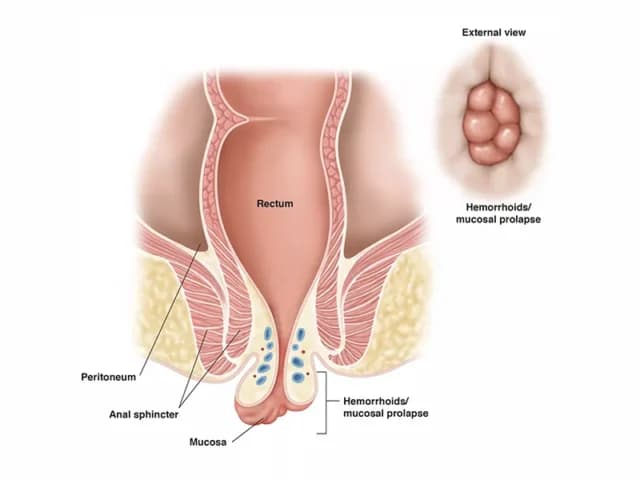
The vascular cushions in the anal canal exist in all of us and serve a purpose; they seal the canal softly. The problem is these cushions enlarging under constant pressure: straining with constipation, long minutes on the toilet with a phone, a sedentary desk-bound life, heavy lifting, pregnancy. In most patients, hemorrhoids are a "disease of habits"; and what habits bring on, habits can reverse.
At which stage is home improvement a real possibility?
There are roughly four grades. Grade 1: not visible externally, bleeds occasionally. Grade 2: prolapses with straining, retracts on its own. In these two grades, the right home protocol shrinks the complaints to near zero within months in most patients. Grade 3 (needs to be pushed back by hand) and grade 4 (permanently outside) are another story: home care provides comfort at best, but structural prolapse does not reverse. Permanent external lumps you can feel and clotted, thrombosed swellings belong in the same group.
The home treatment protocol: Four pillars
First pillar; fiber and water: 25-30 grams of fiber a day (vegetables, fruit, whole grains, legumes; a psyllium supplement if that's not enough) and at least 2 liters of water. The goal is simple: a soft stool, passed in one go, without straining. Until constipation is solved, everything else is a band-aid. Second pillar; sitz baths: warm water, 10-15 minutes, 2-3 times a day. It relieves pain and improves circulation in the area. Third pillar; toilet discipline: no more than 5 minutes on the toilet, no phone, and if nothing is happening, get up. Postponing the urge and forcing it are equally harmful. Fourth pillar; movement: break up long sitting spells every hour; half an hour of walking a day is the bowel's most natural medicine.
This protocol comes with an honest promise: in grades 1-2, applied consistently, it brings a clear reduction in bleeding and discomfort within 4-8 weeks. If it isn't working, your stage is more advanced than you think; time for an examination.
Creams, suppositories, medications: Realistic expectations
Pharmacy products do two things well: soothing burning and itching in the acute phase, and partially reducing swelling. What they cannot do is return an enlarged vessel to its former state; the "lump" that shrinks with a cream was mostly edema to begin with. Two warnings: do not use cortisone-containing creams for longer than a week (they thin the skin and worsen the picture), and do not delay the diagnosis by cycling through creams for months; not everything that bleeds is piles.
Natural remedies: What works, what doesn't
The ones that work are already in the protocol; fiber, water, baths, movement; these are "natural treatment" itself. As for the rest of the internet: garlic, vinegar, baking soda, or toothpaste applied to the area burns the skin; the contents of "herbal hemorrhoid ointments" are unregulated; ice blocks placed on the toilet seat cause tissue damage. The rule stands: apply nothing to the area that a physician has not recommended. Herbal teas taken by mouth are harmless, but their effect is indirect, working through constipation.
A safety note: Take bleeding seriously
This is the most important paragraph of this article. When you see rectal bleeding, assuming "it's my piles" usually turns out to be right; but not always. Bleeding from higher up in the bowel can present exactly the same way. Insist on an examination in these situations: first-ever bleeding over age 40, a change in bowel habits, a family history of bowel cancer, dark-colored bleeding, weight loss, or fatigue. If the exam shows hemorrhoids, all the better; but let's say so by looking, not by guessing.
If home care isn't working: Knife-free options
If the stage has advanced, don't lose heart; the difficult experience the word "surgery" conjures up is largely a thing of the past for hemorrhoids. Laser hemorrhoid treatment is incision-free, stitch-free, and same-day in suitable cases; most patients are back at work the next day. Which method suits which stage is explained on the treatment page.
Frequently asked questions
Can home treatment make hemorrhoids disappear completely?
In early stages the complaints can fall completely silent and stay quiet for years; in practice, that is "recovery." Structurally enlarged advanced-stage cushions, however, do not return to their former state on their own.
How long should I try before giving up and coming in?
If there is no clear improvement after 4-8 weeks of consistent protocol, or if bleeding recurs during that time, it's time for an examination. If there is a painful hard swelling or fever, don't wait at all.
Which foods should be avoided?
There is no strict forbidden list; hot spices can worsen burning during a flare-up, so cut back. The real list is the "add" list: vegetables, fruit, whole grains, water.
Does a donut (ring) cushion help?
It may offer short-term sitting comfort; but because of the view that it can increase pressure in the area over the long term, I don't recommend continuous use. The best cushion is standing up often.
Sources
- American Society of Colon and Rectal Surgeons (ASCRS) — Clinical Practice Guideline for Hemorrhoids, fascrs.org
- NHS — Piles (Haemorrhoids) patient information, nhs.uk
- Turkish Society of Colon and Rectal Surgery, tkrcd.org.tr
Clarifying your stage is a ten-minute examination; the rest is easy: 444 8 623, Op. Dr. Yasir Gözü.
Yasir Gozu, MD
General Surgery Specialist
He has worked in anorectal diseases (proctology) for over twenty years, focusing on non-surgical laser treatments for hemorrhoids, anal fistula, anal fissure and pilonidal sinus. He sees patients at Avrupa Cerrahi in Besiktas Levent.
Content owner: Yasir Gozu, MD
Published: July 13, 2024
Last updated: September 8, 2026